
Find out what your sales team really knows about the new release
After every release, each salesperson takes a short test of questions drawn from a library. The results show which region needs more training, and item analysis points at the questions that were too easy or had the wrong answer marked.
Thirty people trained, and nobody knows what stuck
Kestrel Software sells planning software through 32 account executives in three regions. Each quarter brings a release, and Northbridge Advisory, our example consulting and training firm, runs the sales training that goes with it.
The training ended with a quiz in a shared spreadsheet. Answers travelled from one person to the next within an hour, the same ten questions came back every quarter, and nobody could say whether a low score meant the salesperson hadn’t listened or the question itself was wrong.
Kestrel’s sales director wants two things: a fair check of each person, and a clear view of which topics need another session, and where.
What Northbridge sets up, step by step
A library of questions by topic
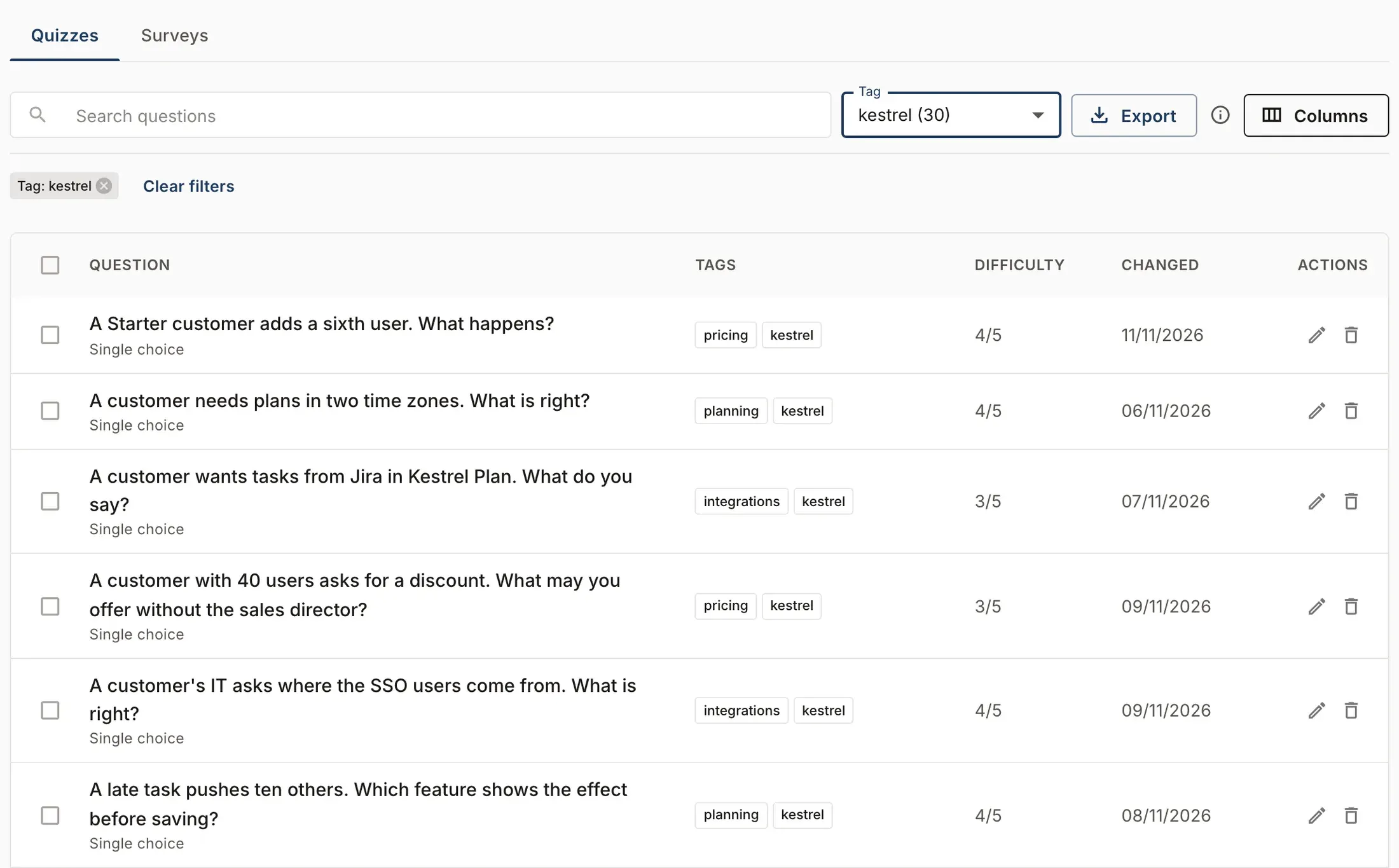
Every question written for Kestrel goes into the question library with a tag for its topic,
pricing,integrationsorplanning, and a Difficulty from 1 to 5. Last quarter’s questions stay there, and new ones join them with each release.
Each attempt draws its own questions
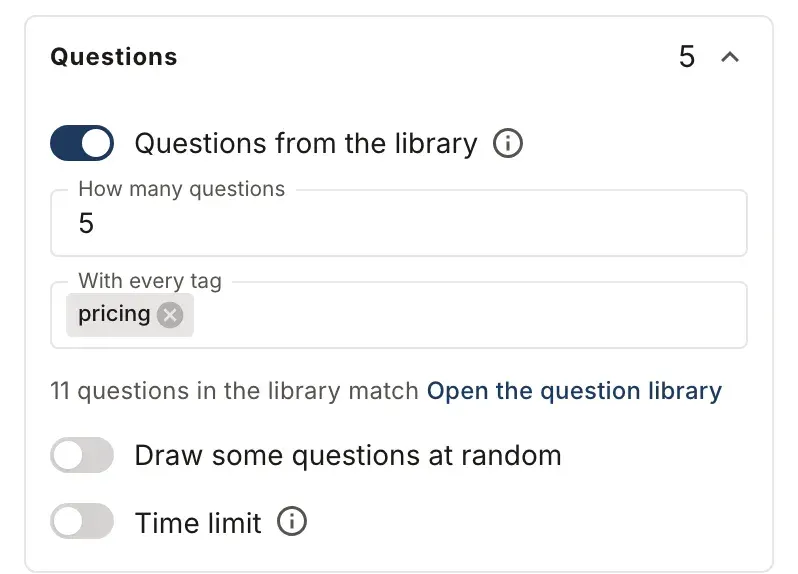
The quiz “Kestrel product check – Q4” has three sections, one per topic, each with Questions from the library set to 5 questions With every tag of its topic. Each salesperson gets 15 questions of their own, and with Shuffle the options on, even a question two colleagues share looks different. The score is out of the questions each person was served.
The team, by region
The access list comes from Kestrel’s staff file: Add people, then From a file, with the file’s Region column chosen as the Group column, so every attempt knows where its salesperson works. The quiz is for Invited people (personal links). On Monday, Send invitations sends each one a personal link with a Deadline of Friday and a reminder on day 3, Thursday morning.
Item analysis finds the weak questions
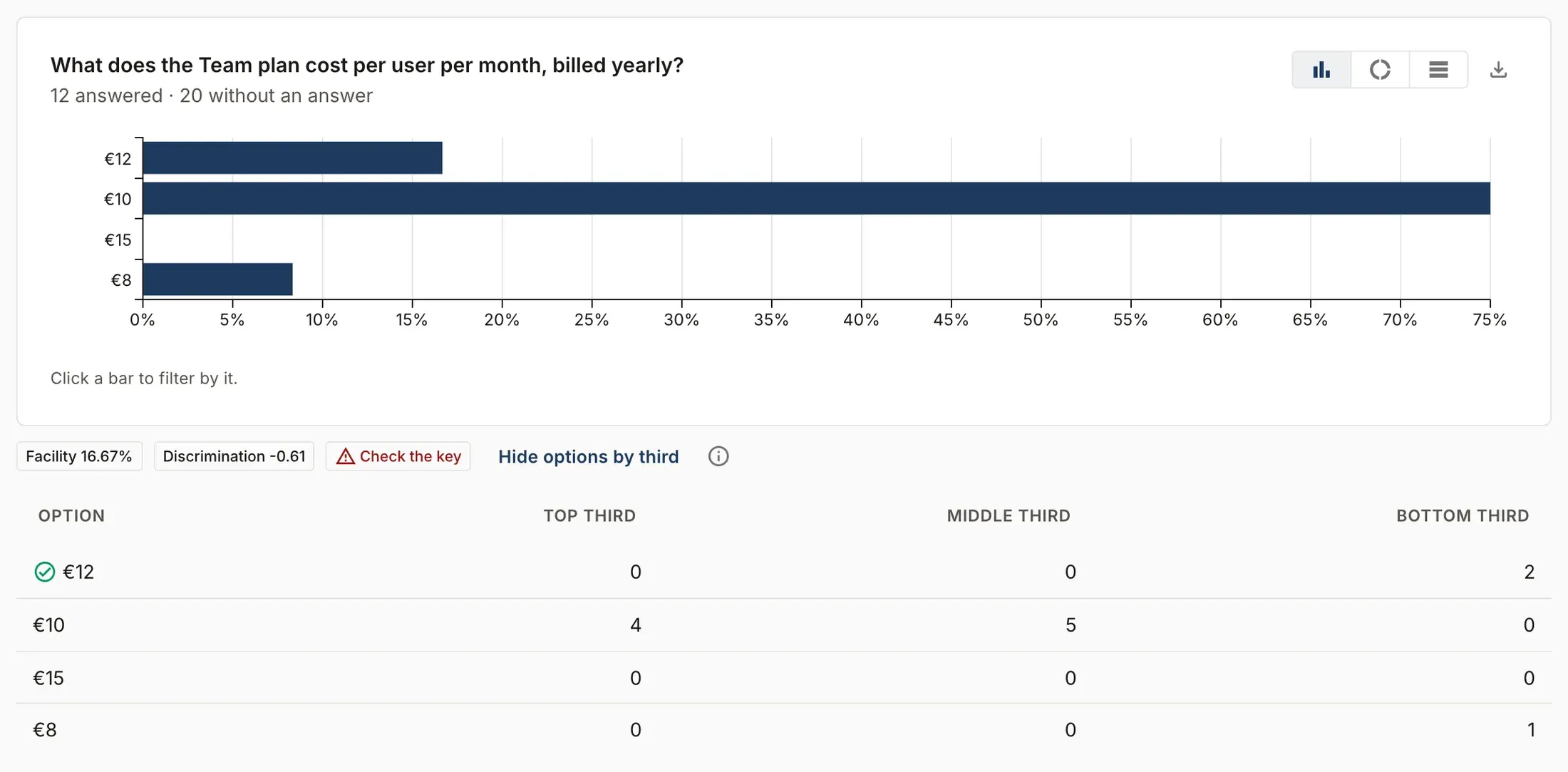
On the Questions tab of the results, each question shows its item analysis. One pricing question is flagged Check the key: the weaker salespeople did better on it than the stronger ones, and Options by score third shows the top third choosing an option marked wrong. It turns out the price list changed after the question was written. Another is flagged Too easy, and Northbridge takes its tag off in the library, so next quarter’s draw leaves it out.
Fix the key and regrade
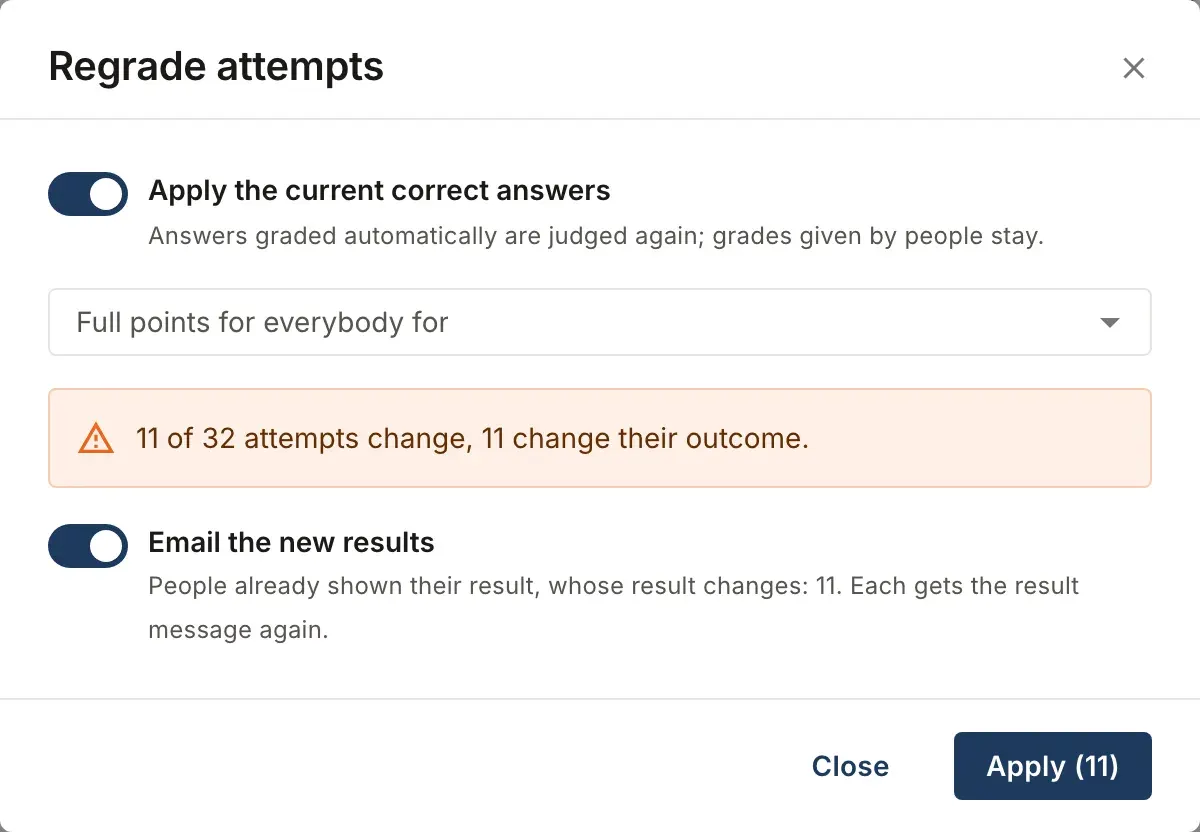
Northbridge corrects the answer in the designer, then chooses Regrade on the Grading tab of the results, with Apply the current correct answers. Check shows how many attempts change, and how many change their outcome, before anything is written. E-mail the new results tells the people whose result changed.
Compare the regions
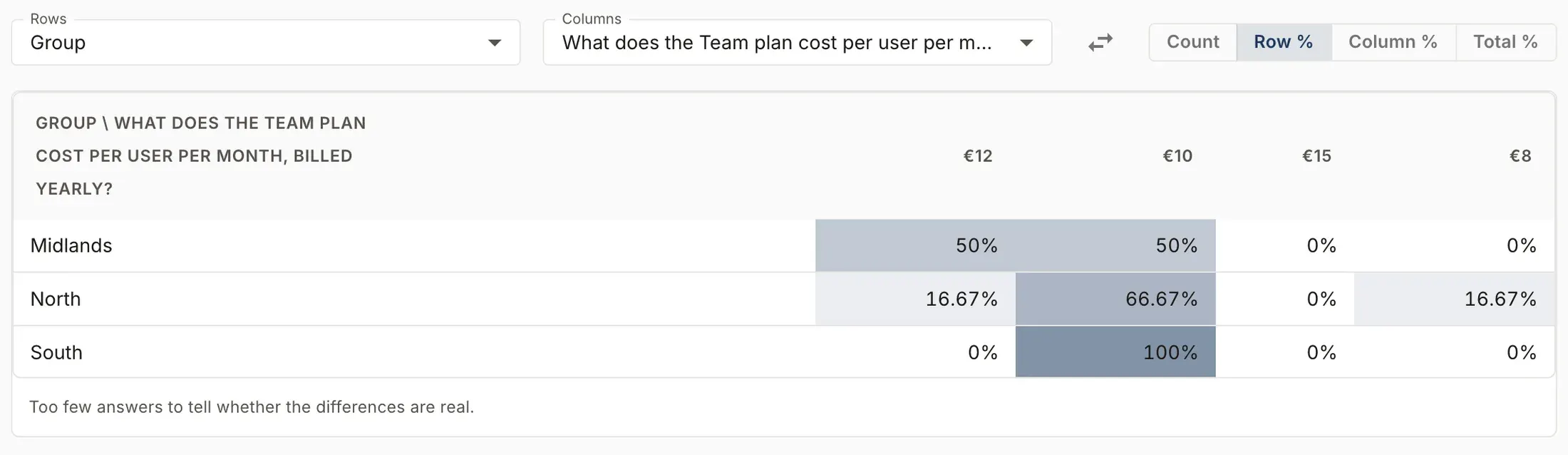
The Cross-tab sets the group against a question’s answers, and on Pro and Business it says whether the difference goes beyond chance. The Summary tab, filtered by Group, gives each region’s mean and pass rate, and its Excel (.xlsx) export goes to the sales director with each section’s subtotal per person.
What you set up once
- The questions in the question library, tagged by topic and given a difficulty
- A quiz with one section per topic, each drawing from the library
- The team, uploaded from a file with a group column
- An email integration for the invitations and reminders
Ways to adapt it
- Next quarter in two minutes
- Duplicate the quiz with Also copy the access list on. The people come along, each with a new personal link, and the sections go on drawing from the same library, now with the new questions in it. Switch the copy on and send the invitations.
- A test for every new hire
- A workflow on A contact is saved sends the quiz with Send a quiz the day a new salesperson’s contact is created, each with a personal link of their own.
- Ask Doxie
- Ask Doxie which questions the team found hardest. She answers from the quiz’s results and its item analysis, never with a person’s name or answers.
- What it is not good for
- Item analysis needs people to learn from: with a handful of attempts its figures say little, and the results page warns below five. And a quiz shows what people know, not how they sell. Pair it with what your CRM tells you.
Questions people ask
Are the questions really different for each person?
Each section draws its questions at random for every attempt, and two sections never draw the same question. With more questions in the library than you draw, colleagues mostly see different ones, and shuffled options make even a shared question look different.
What do facility and discrimination mean?
Facility is the average share of a question’s points people earned; above 90 % it is flagged too easy. Discrimination says how well it separates stronger from weaker participants, from -1 to 1, and above 0.3 is good. Below 0 the weaker did better than the stronger, which usually means a wrong key or an unclear question.
Does a regrade overwrite grades an examiner gave by hand?
No. A regrade judges the automatically scored answers again by the new key; grades given by people stay as they were.
Can a salesperson retake the test?
If you allow it. Limit attempts sets how many, and The attempt that counts decides whether the best, the last or the first one is their result.
Which plan do I need?
Quizzes, the question library and item analysis are on every plan, within its limits of quizzes and attempts. Comparing more than two segments, the cross-tab’s significance test and the AI analysis come with Pro and Business. Pricing has the numbers.
Features behind it
In the manual
Start with one document.
Take the contract you retype most often and turn it into a template. The Free plan is enough, and you need no card.