

Pipedrive integration
A Pipedrive integration connects your company’s Pipedrive account, a CRM where your sales team keeps its people, organizations and deals, to Doxtly. Your salespeople stay in Pipedrive, and the paperwork follows them: a deal moved to Contract sent starts a workflow that writes the agreement, and once the client signs, the deal is marked won and the signed PDF is attached to it.
Available when: your plan includes CRM integrations (Pro and Business), and you hold Manage integrations
On a plan without CRM integrations, Pipedrive isn’t offered among the types. An integration made earlier stays in the list, and opening it shows “CRM integrations are not in your plan” with See the plans. See Plans and limits.
What needs it
Section titled “What needs it”- the four workflow steps of the CRM group: Sync a contact with the CRM, Update a deal, Attach files in the CRM and Add a note in the CRM
- the CRM trigger, which starts a workflow when a deal changes stage or status, or a person is saved in Pipedrive
- people from Pipedrive suggested wherever you type an address, such as a party of a package, and brought into your contacts when you pick one. See Where contacts help you
You can connect several Pipedrive companies, each as its own integration.
How Doxtly knows which record is which
Section titled “How Doxtly knows which record is which”Doxtly copies nothing of Pipedrive’s deals and keeps no deal of its own. It remembers Pipedrive’s IDs in custom fields you choose: a contact’s field holds the ID of its person in Pipedrive, a company’s field its organization’s, and a document package’s field its deal’s. Through these fields a workflow started by a deal finds the contact it belongs to, and a workflow started by a signature knows which deal to mark as won.
So before you connect, it helps to add three text fields, one of contacts, one of companies and one of packages, such as “Pipedrive person ID”, “Pipedrive organization ID” and “Pipedrive deal ID”. You can also add them later. See Pipedrive IDs for what such a field must be.
Connect with an admin account
Section titled “Connect with an admin account”Pipedrive tells Doxtly only about the deals and people the connected user can see. A workflow that should start on every deal of the company, not only on one salesperson’s, needs a user who sees them all. Connect a Pipedrive admin, or an account made for this such as doxtly@northbridge.example, rather than a salesperson’s own.
Everything Doxtly writes in Pipedrive, such as a person, a note or a file, is written as that user.
Connect Pipedrive
Section titled “Connect Pipedrive”- Go to Organization, Integrations, click New integration and pick Pipedrive in the CRM group.
- Fill in Integration name, such as “Northbridge Pipedrive”.
- Click Connect Pipedrive.
- Pipedrive asks you to sign in, and lists what Doxtly asks for: your people and organizations, deals, search, your user’s details and webhooks. Agree to it.
- You return to the integration, which is now Active and shows “Connected as” with the user’s name and the company.
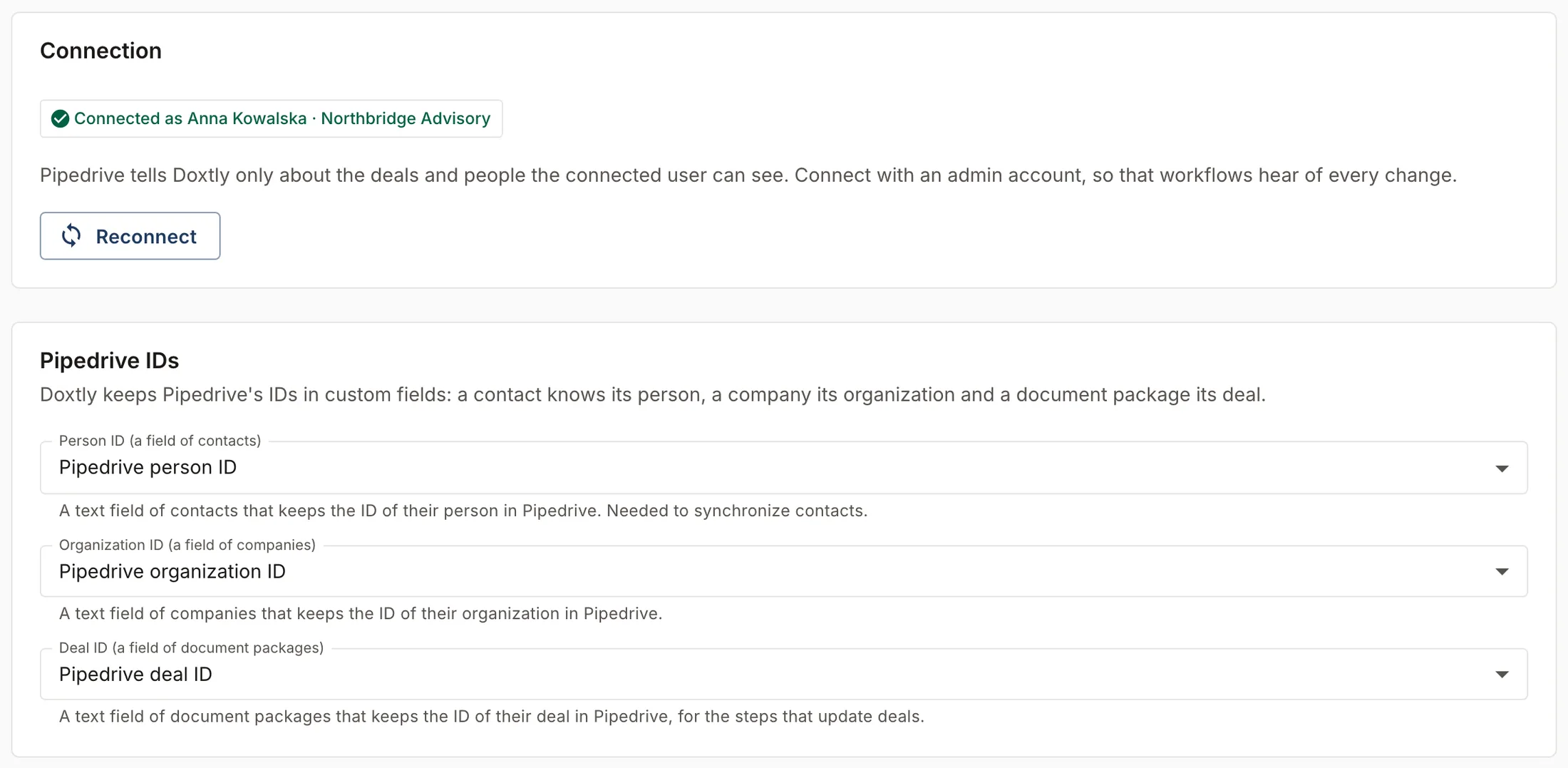
Until it is connected, the page says “Connect your Pipedrive company to continue: you’ll be asked to let Doxtly access it.” A new integration has no Save button at this point, because connecting is what creates it. If you stop at Pipedrive’s page, you find a Draft in the list. Open it and click Connect Pipedrive again.
The Pipedrive IDs and Field mapping cards appear once the integration is Active.
Pipedrive IDs
Section titled “Pipedrive IDs”Choose the custom field that keeps each kind of ID, then click Save.
| Field | A field of | What needs it |
|---|---|---|
| Person ID (a field of contacts) | Contacts | Sync a contact with the CRM, and the people from Pipedrive suggested where you type an address. Without it, neither works. |
| Organization ID (a field of companies) | Companies | Finding a contact’s company in Pipedrive by its ID rather than by its name. |
| Deal ID (a field of document packages) | Document packages | Steps that work on a package’s deal: they offer the field’s variable, such as {{ _package.fields.pipedriveDealId }}, to fill in with one click. |
Each is optional, and None leaves it unset. A field can keep the IDs only if it is:
- of the type Text. The lists offer only text fields that are not sensitive.
- not sensitive. A sensitive value is kept encrypted and can’t be looked up.
- unique, so that one ID names one record. When the field you chose isn’t, a warning says “Values of this field may repeat, but an ID must name one record. Make the field unique to use it.” Click Make it unique. Doxtly refuses if two records already share a value, and names them, so you can correct them first. Without the permission to manage that kind of custom field, the warning asks you to find someone who has it.
- not the ID field of another integration.
The field fills itself in. A contact synchronized with Pipedrive gets its person’s ID, and its company the organization’s. You can also type an ID into a contact’s field by hand, for a contact you know is already in Pipedrive. A package gets its deal’s ID from a workflow, for example from the run of a deal’s trigger, or from whoever fills in the package’s fields.
Field mapping
Section titled “Field mapping”The Field mapping card says which values of contacts and companies go to which fields of Pipedrive’s people and organizations, and back. A fresh integration starts with this mapping, so synchronizing works without any setting:
| Doxtly value | Pipedrive field |
|---|---|
| First name | First name |
| Last name | Last name |
| Phone | Phone |
| Job title | Job title |
| Company name | Name, of the organization |
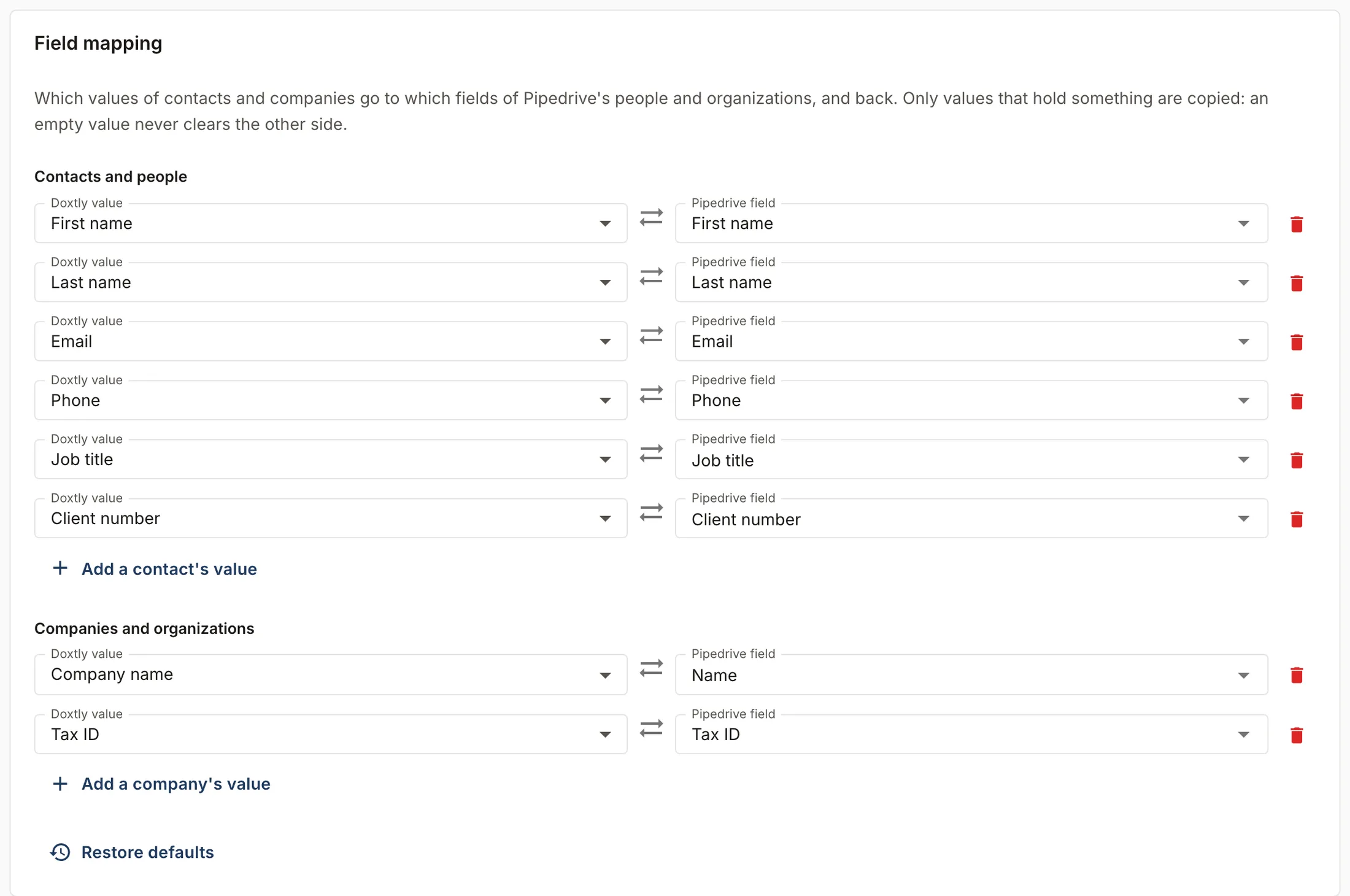
To copy more, click Add a contact’s value or Add a company’s value, pick the Doxtly value, a built-in value or one of your custom fields, and the Pipedrive field. Pipedrive’s own custom fields carry the chip Custom field. The bin removes a row, and Restore defaults brings back the mapping above.
- Tax ID can go only to a custom field of Pipedrive’s organizations, because Pipedrive has no field of its own for it. Add one in Pipedrive first, such as “Tax ID”.
- Each value, and each Pipedrive field, can be mapped once for people and once for organizations. At most 60 rows.
- Only values that hold something are copied, in either direction. An empty value never clears the other side, so a contact without a phone number leaves the person’s number as it is.
- A mapped custom field shows in the field’s usage when you delete it, but deleting it is allowed. Its row is then skipped.
Doxtly reads Pipedrive’s fields as you choose them. If Pipedrive can’t be reached, the card says “Pipedrive’s fields could not be read:” with the reason.
Every field
Section titled “Every field”| Field | What it does |
|---|---|
| Integration name | Your label, shown wherever people pick a CRM. Up to 255 characters, unique among your Pipedrive integrations. |
| Set as default | Makes this the integration offered first wherever a CRM integration is chosen. See the default integration. |
| Connect Pipedrive, Reconnect | Takes you to Pipedrive, to sign in and let Doxtly access the company. |
| Person ID, Organization ID, Deal ID | The custom fields keeping Pipedrive’s IDs. See Pipedrive IDs. |
| Field mapping | Which values are copied between contacts and companies and Pipedrive’s people and organizations. |
| Test connection | Reads the company’s pipelines, to check that the connection still works. Nothing is changed in Pipedrive. It works once the integration is connected and your changes are saved. When Pipedrive no longer takes the connection, the integration turns Invalid. |
Changes in Pipedrive reach Doxtly
Section titled “Changes in Pipedrive reach Doxtly”To learn when a deal or a person changes, Doxtly keeps a few webhooks in your Pipedrive company: addresses Pipedrive calls when something happens. You don’t set them up. Doxtly makes them as you connect, checks them every hour, makes again any that Pipedrive switched off or someone deleted, and removes them when you delete the integration. Pipedrive lists them among your company’s webhooks; leave them be.
- A workflow listening to a deal or a person starts within moments of the change. See the CRM trigger. An outgoing webhook that takes the CRM’s events is called just as soon.
- A change Doxtly made itself, such as a workflow moving a deal or sending a contact, starts no workflow, so two workflows can’t keep each other going. A change someone makes in Pipedrive a moment later is heard as usual.
- When two people, organizations or deals are merged in Pipedrive, the record merged away disappears. Doxtly moves the surviving record’s ID into the contact, company or package that kept the old one, so the link holds. The contact’s history shows the change, made by CRM.
If another record of yours already keeps the surviving ID, Doxtly can’t give it to both. The ID stays where it is, the other record’s field is cleared, and the people who manage integrations get the notification A CRM merge unlinked a record: “Two records merged in Northbridge Pipedrive were linked to “…” and “…”. The ID … stays with “…”; “…” is no longer linked to the CRM.” Its Open the record opens the contact, company or package that lost its link, so you can decide whether the two are one and the same.
When the connection stops working
Section titled “When the connection stops working”The integration turns Invalid when Pipedrive no longer takes the connection, for example because Doxtly’s app was removed from your Pipedrive company or the connected user lost access to it. Workflow steps on it fail with “Pipedrive no longer accepts Doxtly’s connection. Connect the integration again.”, and the page says “Pipedrive no longer accepts this connection. Connect it again.”
Open the integration and click Reconnect. Your Pipedrive IDs and field mapping are kept.
Reconnecting must reach the same Pipedrive company, because the IDs your contacts, companies and packages keep are that company’s. Signing in to another company is refused, and the integration stays connected to the one it had. To work with a second company, add a new integration.
Pipedrive’s limits
Section titled “Pipedrive’s limits”Pipedrive limits how many requests a company may make, in short bursts and per day, across every app it uses.
- A short burst over the limit: Doxtly waits a few seconds and tries again by itself. If that’s not enough, the step fails with “Pipedrive is limiting the number of requests. Try again in a moment.” Rerun the run a little later.
- The day’s requests used up: the step fails with “Your Pipedrive company has used up its requests for today. Try again tomorrow.” Nothing reaches Pipedrive until its new day begins.
Other refusals a step can meet are on each step’s page.
What you see once it’s set up
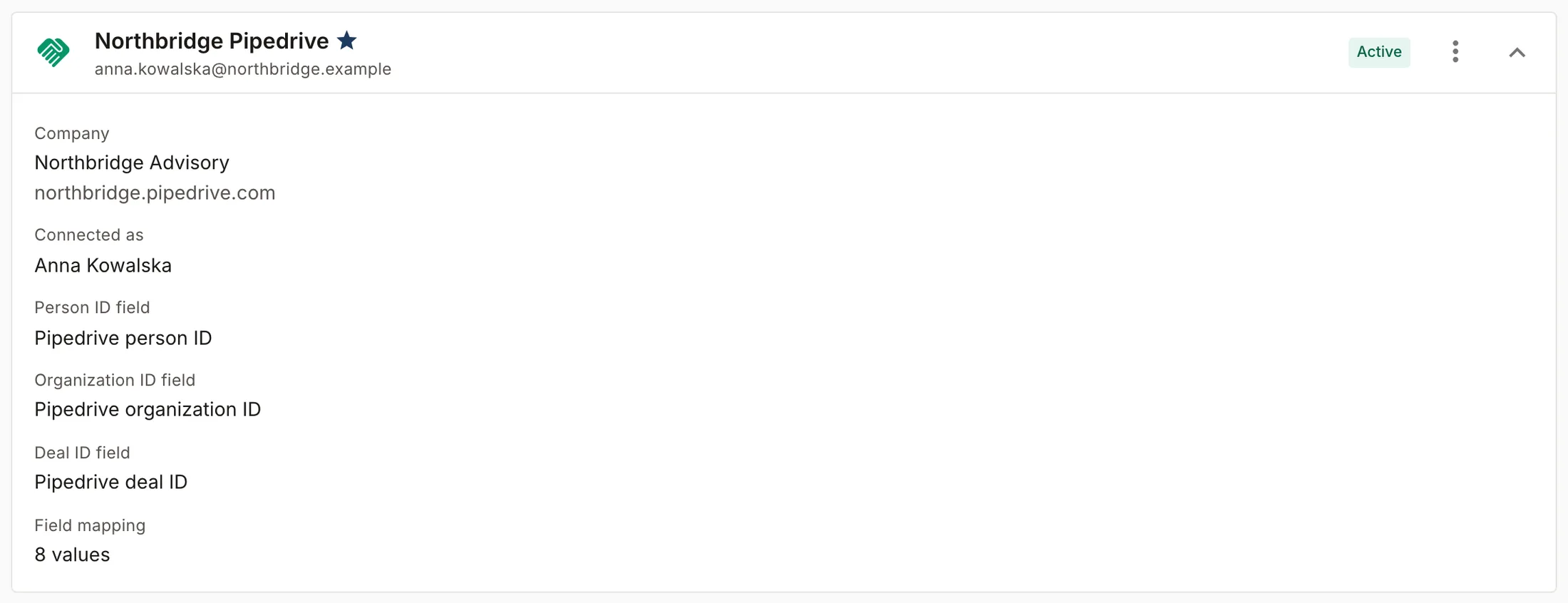
Section titled “What you see once it’s set up”Click the row in the list for the summary: Company, Connected as, the three ID fields with the field chosen or None, and Field mapping, with the number of values mapped and whether it is the default.
What Doxtly reads and writes in Pipedrive
Section titled “What Doxtly reads and writes in Pipedrive”| Reads | Writes | |
|---|---|---|
| The user and company | The connected user’s name and email address, and the company’s name and Pipedrive address, when you connect | Nothing |
| People and organizations | A person or organization, to synchronize a contact, to suggest a person, or when its change starts a workflow | A person or organization a synchronization sends: only the fields you mapped, and the person’s organization |
| Deals | A deal whose change started a workflow, with its pipeline and stage | The stage, status, value, currency and fields an Update a deal step sets |
| Pipelines, stages and fields | Their names, as you choose them in a step, a trigger or the mapping, and the pipelines when you test the connection | Nothing |
| Files and notes | Nothing | The files and notes your steps add |
| Webhooks | Its own | Its own, as above |
Doxtly never deletes anything in Pipedrive but its own webhooks.
Delete a Pipedrive integration
Section titled “Delete a Pipedrive integration”Deleting the integration removes its webhooks from Pipedrive and ends the connection. An Invalid integration can no longer reach Pipedrive to remove them, so delete them among your company’s webhooks in Pipedrive. Workflow steps on it then fail, and workflows listening to it no longer start, so check them first. The custom fields keep the IDs they hold, and nothing in Pipedrive is deleted. See Delete an integration.