

Taking a quiz
A quiz reaches people through one public link, and they need no account. This page covers how to hand out the link and what the person on the other end goes through, so you can write your instructions and answer their questions.
Share the link
Section titled “Share the link”Available when: your role has the View quizzes, attempts and results permission
Choose Share in the row menu. The Share the quiz dialog shows the Public link with a copy button, Open the page to try it yourself, and a QR code to download and print. The address ends in /q/ and the quiz’s public token, a random code.
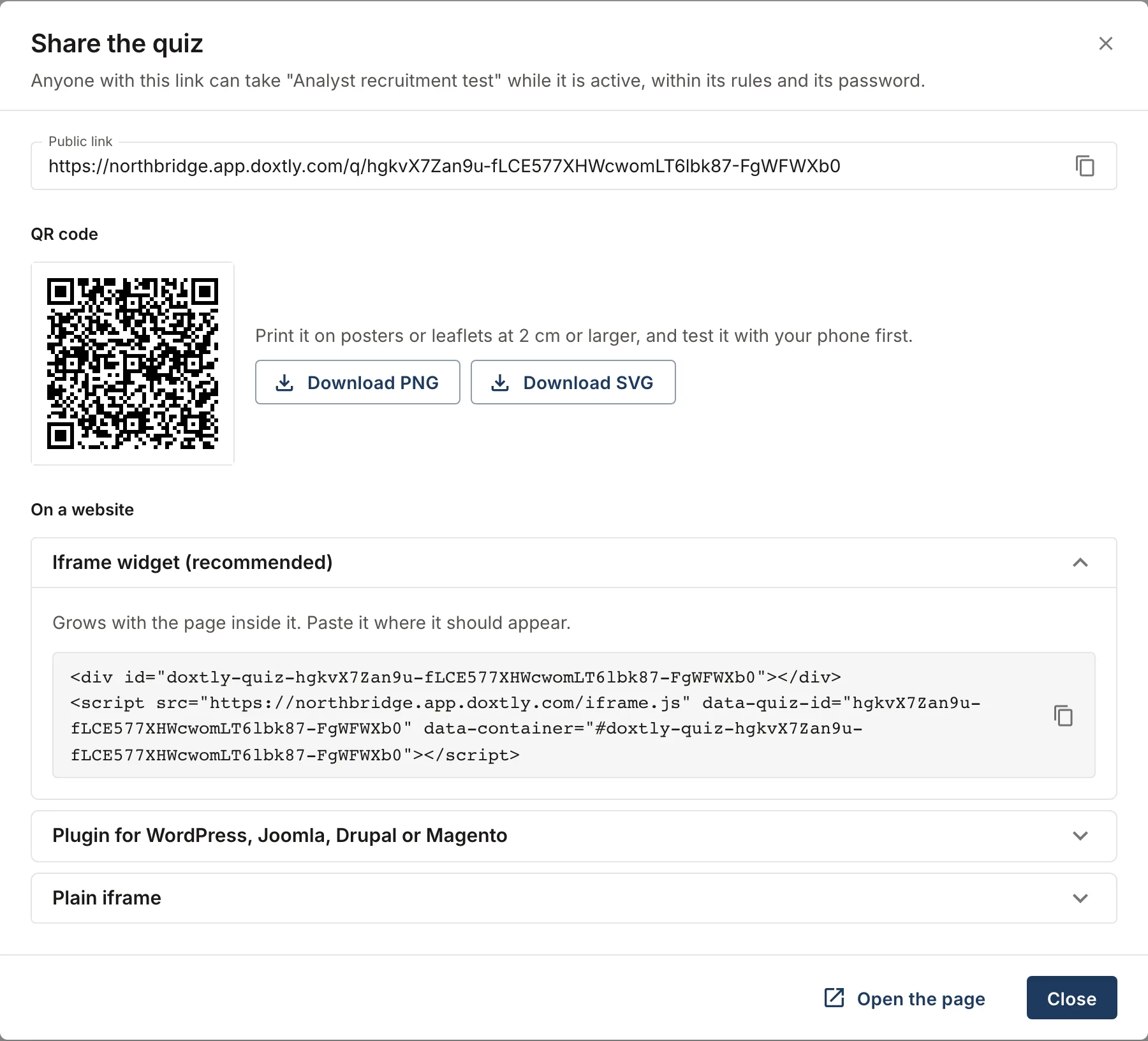
Anyone with the link can take the quiz while it is Active, within its rules and its password, unless it is only for the people on its access list. Put it in an email, a course page or a QR code on the training room’s wall. With link parameters accepted, you can add values such as ?group=A by hand.
On your website
Section titled “On your website”Under On a website the same dialog gives you the snippets with the quiz’s token filled in, on three tabs, as for a form:
| Tab | Snippets | Height |
|---|---|---|
| Script | Simple native embed (recommended) draws the quiz in your page, in its theme, its styles kept apart from your page’s. Advanced native embed does it from code. | Follows the quiz |
| Iframe | Plain iframe for site builders that accept only an iframe tag; iframe widget (auto-resize) and iframe widget (advanced) show the quiz in a frame that grows with it. |
Fixed for the plain iframe, else follows the quiz |
| CMS plugin | [doxtly_quiz id="…"] in a post, page or block of text, with the Doxtly plugin installed, and the same tag with type="iframe" to show it in a frame. In Joomla write it with braces: {doxtly_quiz id="…"}. With an access key saved in the plugin, its block, widget and editor button let you choose the quiz from a list. |
Follows the quiz |
<div id="doxtly-quiz-YOUR-QUIZ-TOKEN"></div><script src="https://app.doxtly.com/embed.js" data-quiz-id="YOUR-QUIZ-TOKEN" data-container="#doxtly-quiz-YOUR-QUIZ-TOKEN"></script>From code, DoxtlyForms.embed({ quizId: 'YOUR-QUIZ-TOKEN', container: '#my-quiz' }), or DoxtlyIframeForms.embed for the frame, takes the same options as for a form: width, minHeight, language, theme, transparent, shadowDom for the script, baseUrl, queryParams, onResize, and onSubmitted, called with the token once the person sends the attempt on that page. theme shows the quiz in another theme of your library on that website, and transparent puts it on your page’s own background. The host page’s own parameters reach the quiz, so a page opened with ?key= gives the person their own access. If the quiz accepts only some websites, put your website’s address on that list: a quiz shown by any other website is not found.
The introduction
Section titled “The introduction”Before the first question the person sees the title, the introduction you built - its headings, paragraphs, pictures and videos -, and how the quiz is taken:
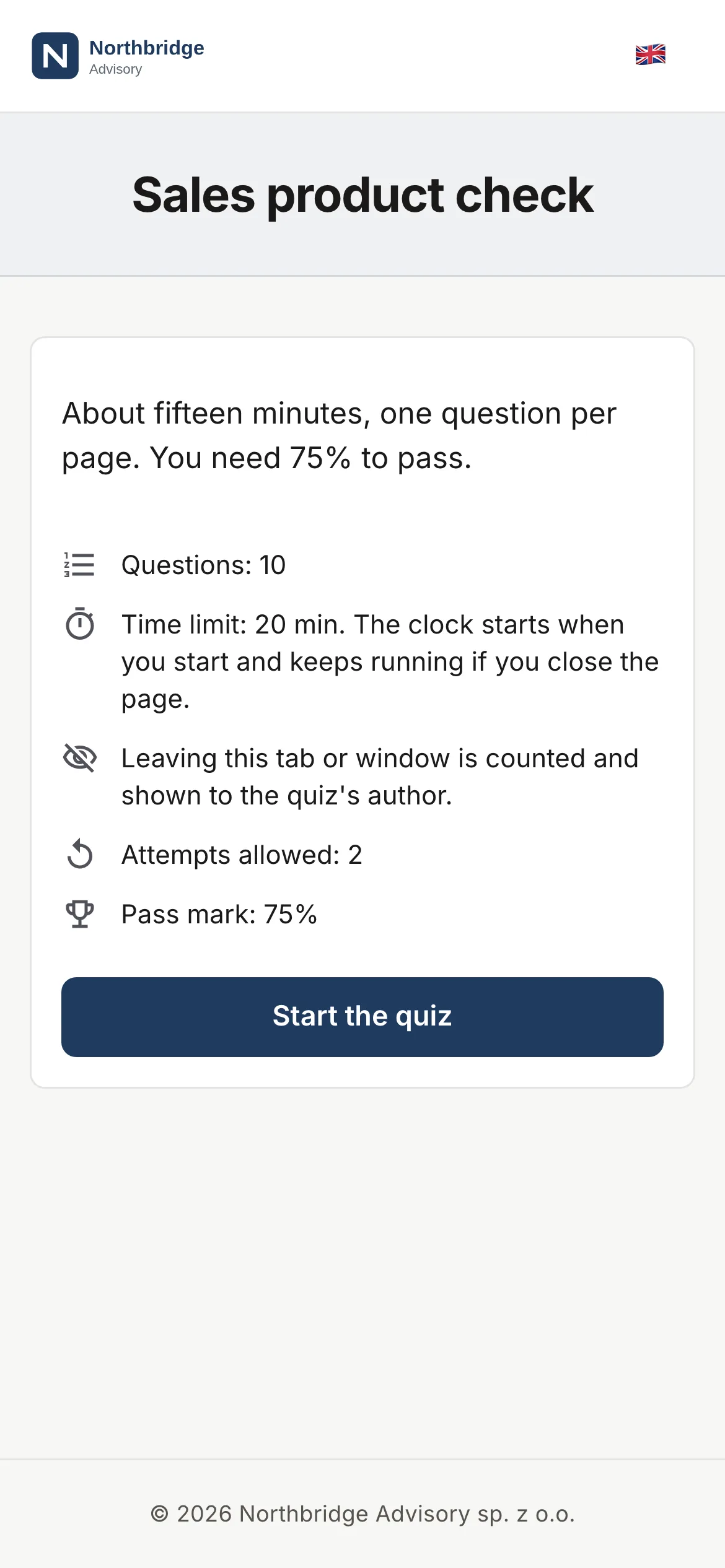
- how many questions there are
- the time limit, or No time limit, and that the clock starts when they start and keeps running if they close the page
- that they go forward only, when the quiz is set so
- that leaving the tab or window is counted, and the limit at which the attempt is sent
- how many attempts they are allowed
- the pass mark
A password-protected quiz asks for the password first; with People with their own passwords, each person types their own. Someone who comes through a personal invitation link is greeted by name (Hello, Helena) and asked for nothing. Without a valid personal link, a quiz for invited people says This quiz is by invitation and asks them to open the link from their invitation email. Start the quiz begins the attempt. With Ask a CAPTCHA to start on, an invisible check runs as they click; if it cannot be loaded, the page asks them to allow google.com in their browser.
The time limit
Section titled “The time limit”The countdown on the page is the server’s. The attempt’s deadline is set on the server as it starts, and the page counts down to it, warning at five minutes and at one minute left. Changing the computer’s clock changes nothing.
- The time keeps running if the page is closed. Someone who closes the tab and comes back later finds less time left, or the attempt already sent.
- When the time runs out, the attempt is sent as it stood, with the answers saved so far. If the page is still open, it sends it. If it is not, the server sends it on its own within a minute, and its workflows start as for any other attempt.
- A request a little late still counts. Answers that reach the server up to 10 seconds after the deadline, held up by the network, are still saved.
The result page then says The time ran out, so your answers were sent as they stood.
Answering
Section titled “Answering”Answers are saved as the person types, and the page checks in with the server every 15 seconds while they think. If saving fails, the page says so and sends them again with the next step, so a short loss of connection loses nothing.
A reload, or closing the browser and coming back, takes the attempt up again in the same browser, with its answers, its order and the time left. Another browser or device starts afresh.
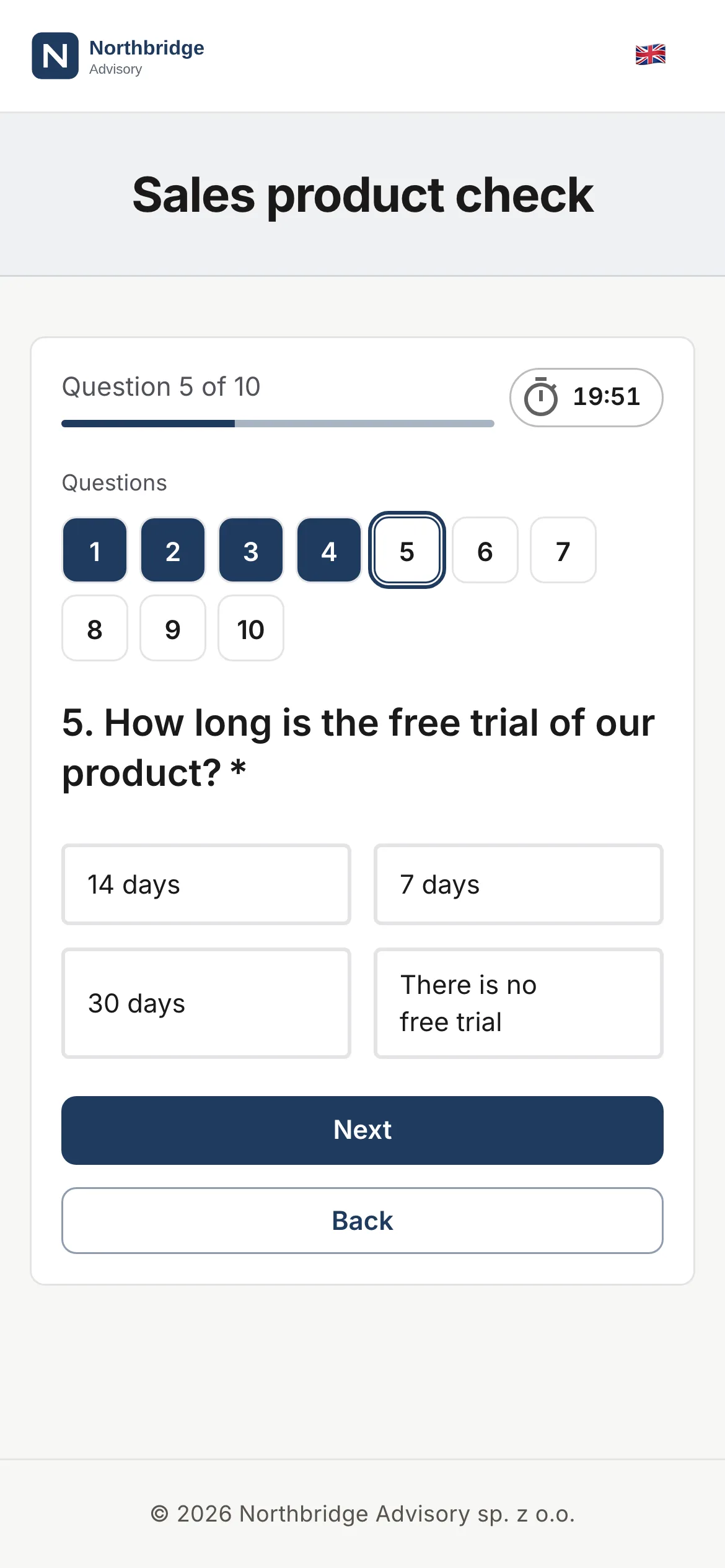
The quiz is split into pages as its settings say: one question per page, one section per page, or everything on one page. With pages, the top of the page shows Question 3 of 12 (or Questions 1-5 of 12 with several on a page) and the progress; Next and Back move between pages, and Send on the last page sends the attempt. Everything on one page has no progress, no list of questions and no Back: only Send.
- Required questions must be answered before Next moves on, and before Send.
- Forward only: Back is not offered, and a page once left is closed. The server refuses an answer to it, so it cannot be changed by any trick either.
- The list of questions, when the quiz shows it, marks each question answered or not. With free moving, clicking a question opens its page.
- Leaving the tab is counted when the quiz counts it. Past the warning threshold, the page shows how often the person has left the tab and, if the quiz sends the attempt at a limit, what that limit is.
- Fullscreen, when the quiz requires it: the page goes fullscreen as the person clicks Start the quiz. Leaving it, with Esc for example, counts as leaving the tab. Until they go back, the page shows This quiz is taken in fullscreen. Leaving it counts as leaving the tab. with Return to fullscreen.
- Pasting, when the quiz blocks it: nothing can be pasted into an answer, and the page says Pasting is turned off in this quiz: type your answer.
- One device, when the quiz holds each attempt to one: a person of the access list, or with a personal link, continues the attempt only in the browser it began in.
The page works on a phone as well as on a desktop.
Pages, sections and filled-in texts
Section titled “Pages, sections and filled-in texts”- Other. A person who picks Other in a choice question types their own answer into a box under it, up to 500 characters. Choosing another option clears the text.
- One section per page. With this paging, each section is one page, with its title and description on top. With one question per page, a section’s title opens its first question’s page, and a page never holds questions of two sections. A section may serve only some of its questions, drawn at random, and the score is out of the questions served.
- The list of questions shows the questions under the title of their section.
- Filled-in texts. Variables in the introduction, the questions, the explanations, the section texts and the result texts are filled in as the person goes, from earlier answers and from the link, and shown as plain text.
- Score by section. The result and the answers shown after sending include Score by section when the quiz has sections.
One question per page
Section titled “One question per page”With One question per page, each question fills the screen in large type, and the answers are tiles that are easy to tap on a phone. The keyboard does the rest:
| Key | What it does |
|---|---|
| 1 to 9, or A to Z | Picks the option with that number or letter, shown beside it. In a multiple choice question it ticks or unticks it. |
| Enter | Goes to the next question, or sends the answers on the last one. In a long answer, Enter starts a new line. |
| Shift + Enter | Goes back to the question before, when the quiz lets people go back. |
Progress is shown as the quiz says in Pages: a bar, a step per page, the percentage done, or not at all. With one section per page the questions are shown in the form’s usual type, and the keys above are not used.
The result
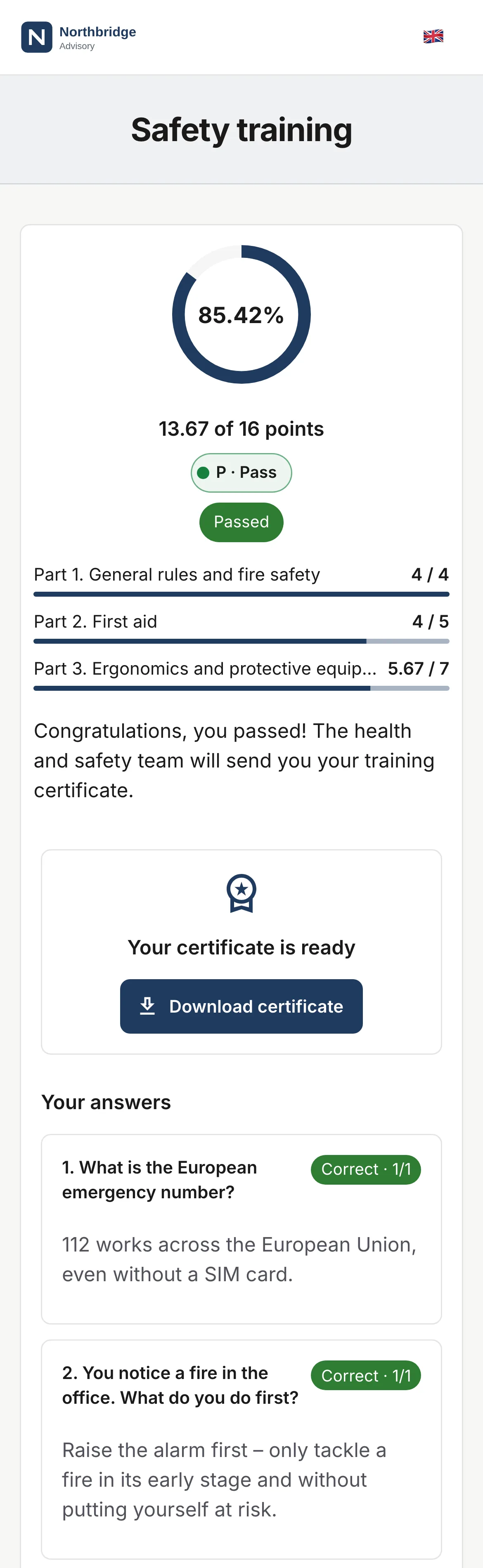
Section titled “The result”What the person sees after sending follows the quiz’s result setting:
| Setting | What they see |
|---|---|
| Only that it was sent | Your answers were sent. |
| The score | The points, such as 9 of 12 points, and Passed or Not passed (pass mark 75%) when the quiz has a pass mark. |
| The score and the answers | The score, then under Your answers each question with the answer given, its verdict and points (Correct · 1/1, Partly correct, Incorrect, Not answered), the correct answer and your explanation. |
When the result is shown later, because the quiz shows it only after grading or when someone releases it, the page says Your answers were sent and You will see your result once it is released. A person whose e-mail is known is sent a link to their result when it is. With a grading scale, the grade shows beside the score.
What a survey’s respondent sees is in Answering a survey.
Open answers graded by AI
Section titled “Open answers graded by AI”When a quiz has questions judged by AI, the result page says Checking your answers while they are graded, usually a few seconds, and shows the result on its own once they are. The person can keep the page open. If the AI cannot grade them, the page says Some of your answers will be graded by the quiz’s author, and the attempt shows Needs review on the Responses tab of the results.
What can go wrong for the person
Section titled “What can go wrong for the person”| They see | Why | What to do |
|---|---|---|
| Nothing to open here, This link is not valid, or what it opened has been closed or removed. | The quiz is inactive or was deleted, or the link is mistyped. | Switch it to Active, or send the right link. |
| The password you entered is incorrect. Please try again. | A wrong password. | Send them the password again. |
| You have used every attempt this quiz allows. | Attempts per person is used up in this browser, or by this person when the quiz has an access list. | Raise the limit in Settings. |
| Not open yet and when it opens | The quiz’s schedule opens it later. | Wait, or change the date. |
| Closed, No more answers are accepted. | The close date has passed. | Move the date, or switch it off. |
| Closed, All places have been taken. | The quiz took all the responses it takes. | Raise the limit. |
| You can try again in 25 min. | The quiz asks for a pause between attempts. | Wait, or shorten the pause in Settings. |
| You have passed already: this quiz gives another attempt only to those who did not pass. | Only people who failed may retake. | Switch that off if everyone may try again. |
| The attempt could not be started. Please try again., or the reason itself | The start was refused, for example because your plan’s attempts for this billing period are used up. | Check the plan limits. |
| This attempt is being taken on another device. Continue there, or ask the examiner to release it. | The quiz holds each attempt to one device, and this one began on another device or in another browser. | The person continues on the device they started on. |