

Sending documents for signature
Packages that repeat go out through a workflow, from its Create documents step. You set it up once, and from then on every form submission, webhook call or recurring run that reaches the step produces a package, with the right people on it and the data already filled in. To send one document once, make a package by hand instead.
Available when: you may manage workflows. Sending a code or a link by email needs the organization's email configuration; a code by SMS or WhatsApp needs the matching integration
Before you start
Section titled “Before you start”You need three things:
- A document that names its signers. A template the step renders itself: a PDF template with signature areas, or a Word or SVG template with
[SIGNATURE:CLIENT]markers in its text. Or a file made earlier in the workflow or sent in with the trigger, with the same markers. Pictures and office documents become PDFs on the way, because only PDFs are signed. A PDF template with areas people fill in or sign goes straight into Create documents: a Generate document step refuses it. - A workflow with a trigger. See Workflow designer.
- A way to send the link. Usually a connected email integration.
Set it up
Section titled “Set it up”Here is the setup for Northbridge’s service agreement, signed by the client and by a partner of the firm.
-
Open the workflow and add a Create documents step. Select it and click Configure this step. A dialog with four tabs opens: Basics, Documents, People and Delivery.
-
On Basics, choose the Document type, for example “Client contracts”. This is required. You can also create a new type right here by typing its name.
-
On Documents, add a document and its fragments: Template and Choose a template, or File from workflow and Choose a file. The dialog shows who the document names under Signed or filled in by.
-
On People, under Parties, say who each party is on this run. Use variables from the form, for example
{{ client_name }}and{{ client_email }}. For the partner, a fixed name and address will do. In each party’s row, say how they sign. -
On Delivery, set the deadline, and on Basics the Signature level (PAdES). Left alone, a package has no deadline and is sealed at PAdES-LT, or PAdES-B on an installation with no timestamp service.
-
Leave Signature request on for each party, and Doxtly asks them to sign when their turn comes. To word the message yourself, turn it off and add a Send email step: see Getting the link to people.
-
Save and activate the workflow, then run it once with your own email address. The step’s card on the run page counts the documents and recipients, and links to the Document package.
The tabs
Section titled “The tabs”Basics
Section titled “Basics”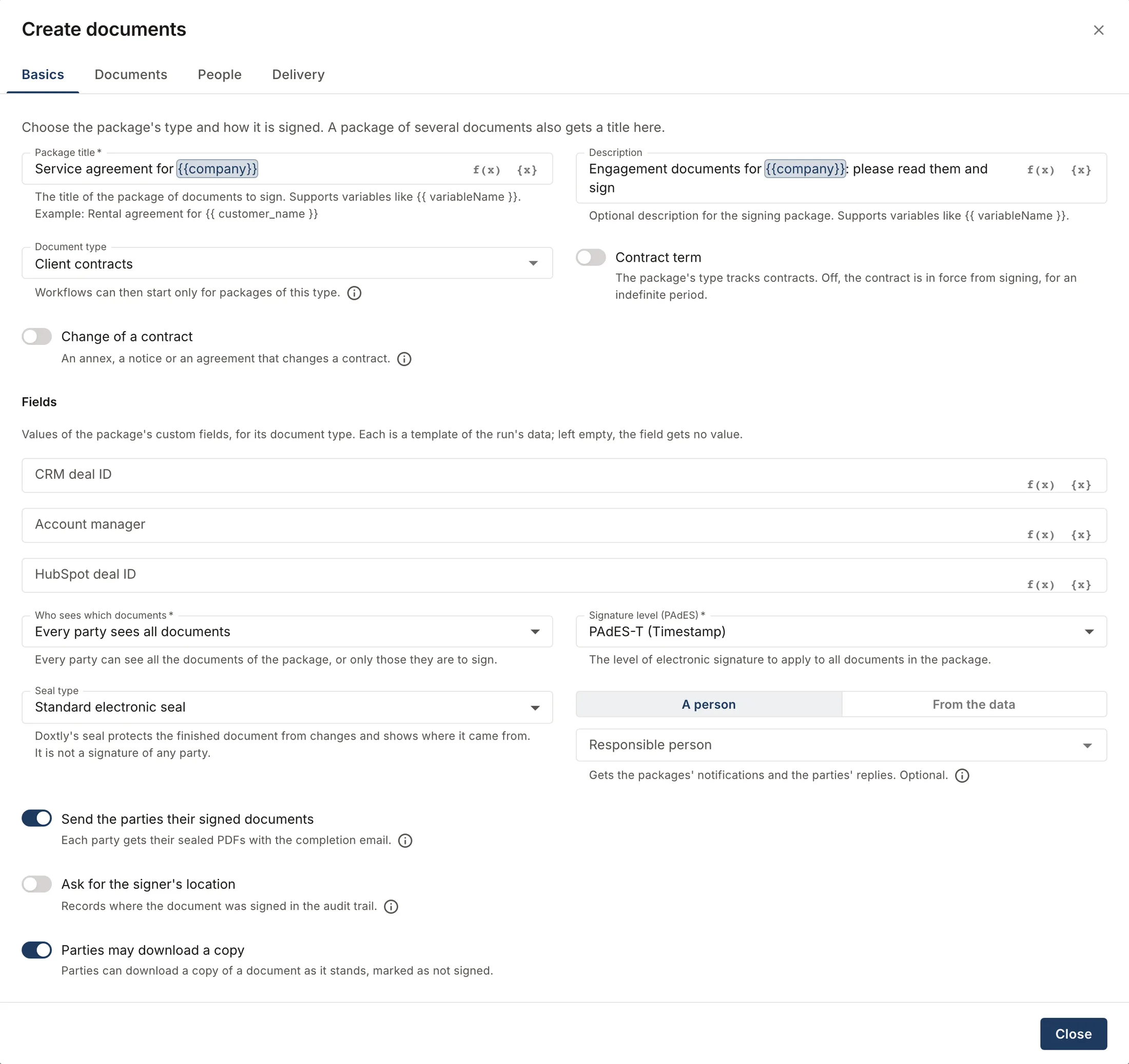
| Field | What it does |
|---|---|
| Package title | The package’s name, shown to the signers and in your list. It supports variables: Service agreement for {{ company }}. Required with several documents; with one document the field isn’t shown and the document’s title is used. |
| Description | An optional line of explanation shown under the title on the signing page. Variables work here too. Like Package title, it appears only with several documents. With one document, that document’s description is used. |
| Document type | Required. It files the package, decides which departments can see it, and is what later workflows trigger on. With Manage document types you can type a new name and create the type here. A type’s rules can fix settings on the other tabs: such a field reads Set by the document type. |
| Who sees which documents | Every party sees all documents (default) or Each party sees only their own. With the second, each person sees just what they sign or fill in, so attachments stay hidden from the parties. Use it when one package carries a separate contract for each party. The rule holds in the app as well as through the link. |
| Signature level (PAdES) | PAdES-B (Basic), PAdES-T (Timestamp), PAdES-LT (Long-term), PAdES-LTA (Archival). A new step starts at PAdES-LT, or at PAdES-B where no timestamp service is available. How long the seal can be proved. See Signature levels. Applies to every document in the step. |
| Seal type | Standard electronic seal (default), or Qualified electronic seal where one is available; Doxtly’s cloud offers none, so there it is greyed out with Not available: no qualified certificate is set up. A document type can fix it. |
| Responsible person | A person or From the data. Who answers for packages this step makes: told when they are refused, not approved, finished, expired or not delivered, and named as the sender in emails. Left empty, the organization’s longest-standing administrator answers for them. See Responsible person. |
| Send the parties their signed documents | On for a new type, as the type sets it. Each party’s sealed PDFs go with the completion message. See What happens after signing. |
| Ask for the signer’s location | Off (default), on. The browser asks each signer to share their location, and the location or the refusal goes into the audit trail. Refusing doesn’t stop anybody from signing. Turn it on only when you need proof of where a document was signed: people tend to refuse a prompt they didn’t expect. |
| Parties may download a copy | On (default), off. Parties can keep a copy of a document as it stands, marked as not signed. |
Documents
Section titled “Documents”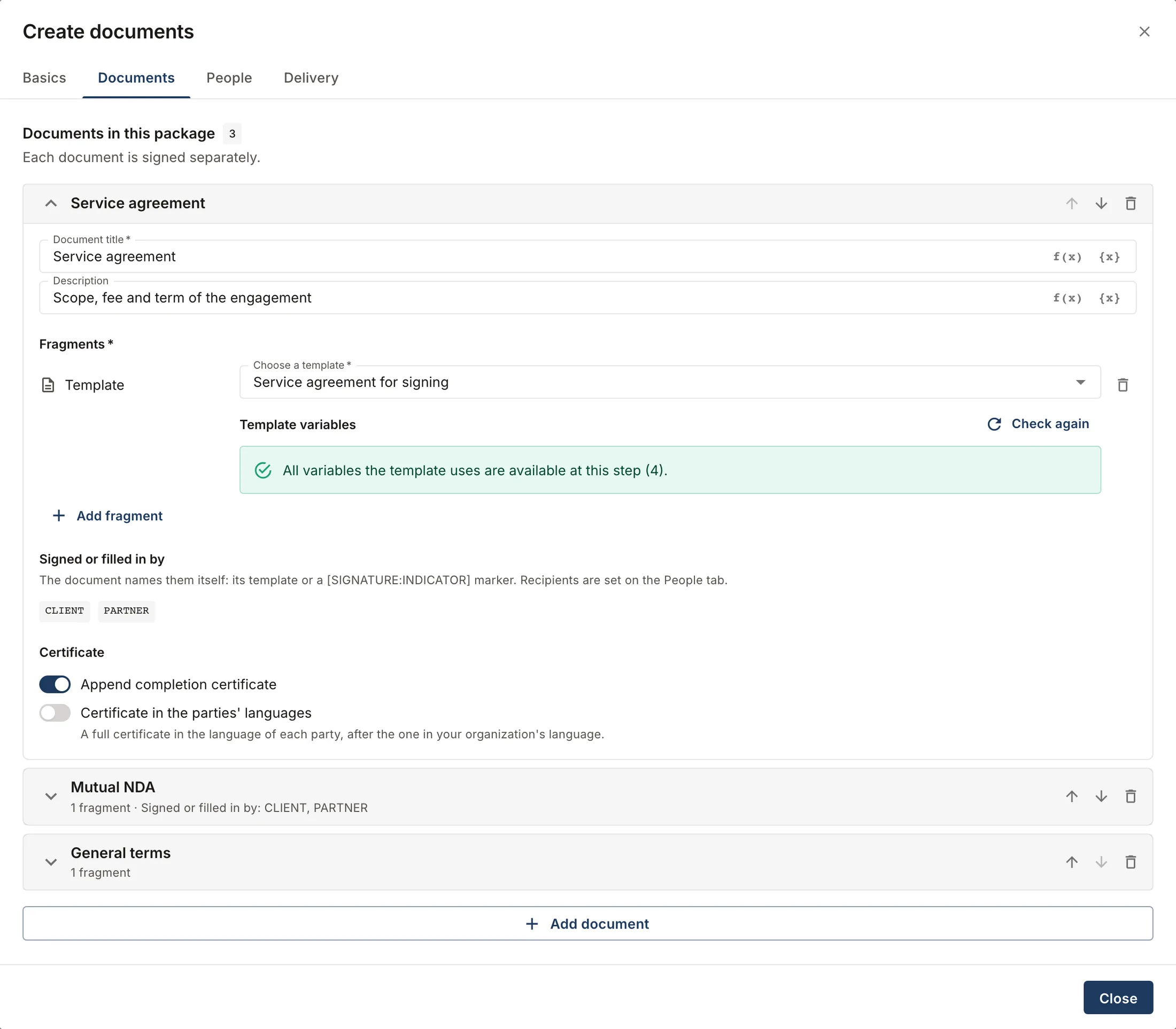
The tab is headed Documents in this package. Each document is a card: click a folded one to open it, move it with the arrows, and remove it with the bin. Add document adds another. The full list of settings is on the Create documents page; these are the ones you meet first:
| Field | What it does |
|---|---|
| Document title | Required. The name the signers see. Supports variables. |
| Description | Optional. Supports variables. |
| Fragments | What the document is made of, joined into one PDF in their order, up to 20. Add fragment adds a Template (pick it in Choose a template: PDF, Word or SVG, rendered on the run’s data) or a File from workflow (pick it in Choose a file: a file from the trigger or an earlier step). Areas of a PDF template the data can’t answer are collected from the parties on the signing page. Under a template, Template variables says whether the step has everything it prints; Check again checks once more. |
| Signed or filled in by | Read only. The parties the document names. |
| Append completion certificate | On by default. Adds the Certificate of Completion, the page that lists each signer’s evidence, to the end of the sealed PDF. Turn it off if the PDF must keep its exact page count. The audit trail is kept either way, and you can still download it as an audit certificate. |
| Certificate in the parties’ languages | Off by default. Follows the certificate with a full copy in the language of each party. |
Parties come from the document, never from a list of signers:
- In a PDF template, from its signature areas and fields.
- In a Word or SVG template, and in a file, from the
[SIGNATURE:INDICATOR]markers in its text. A file nobody can look into in advance, such as a form upload, is read when it arrives on the run, so add a party for each one it may name. - A marker that arrives inside form data doesn’t count, so somebody typing
[SIGNATURE:CLIENT]into a form field can’t create a signature place. - A document that names nobody goes into the package to be read. That is how you attach general terms beside a contract. It holds nothing up, but it can’t be alone: if no document names a party, the run stops.
People
Section titled “People”One page: the parties, then the approvers and the viewers, and the order once there is one to set.
Parties
Section titled “Parties”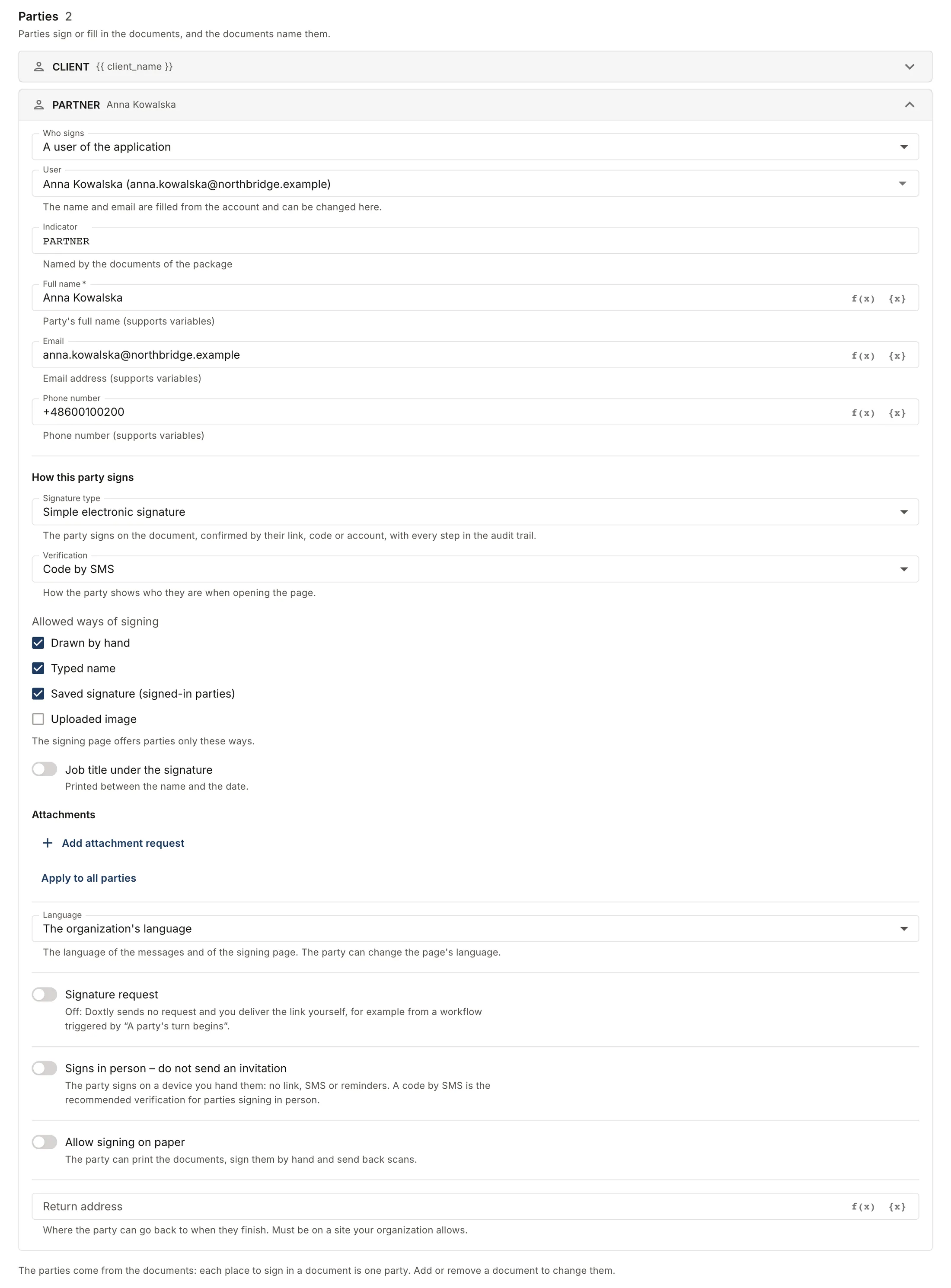
One row per party the documents name, and none besides. To change the parties, change the documents. The exception is a File from workflow whose parties are known only when it arrives: while the step holds one, you type the indicators yourself and add rows with Add party.
| Field | What it does |
|---|---|
| Indicator | The party’s label, taken from the documents. Typed by hand, it starts with a capital letter and holds only capitals, digits and underscores. A party marked conditional takes part only in the runs where its block or area appears. |
| Full name | Required on every run. Printed with the signature. Supports variables. |
| Where the party can be reached. Required for Code by email and for the main party of immediate signing. Also needed for resending the link and for the completion notice. Supports variables. | |
| Phone number | Required for Code by SMS and Code by WhatsApp. Supports variables. |
| Who signs | First thing in the row, with User below it for a user of the application: someone outside the application (the default), a user of the application or, where you have departments, anybody in a department. A user is chosen from a searchable list and links the party to a person in your organization, who can then sign inside Doxtly; a variable can still fill the fields below instead. You choose from the people who may read documents of the package’s type, so pick the type first. If you change the type and the person can’t read it, the link is removed. |
| How this party signs, Language, Signature request and the switches below them | How this party signs, in the same form as a package made by hand: see How parties sign. |
A party whose email address is the address of a user in your organization is recognized as that user even without the link. If a linked person has left by the time the workflow runs, the package is still created, without the link.
The designer flags what it can before you save: a missing name, or a missing address or number that the way of signing needs. The step then checks everything again on each run, before it creates anything. If a document names a party with no recipient, a name renders empty, or a code is required and the address or number is missing, the run stops and no half-built package is left behind. You see the reason in the run’s details.
Viewers
Section titled “Viewers”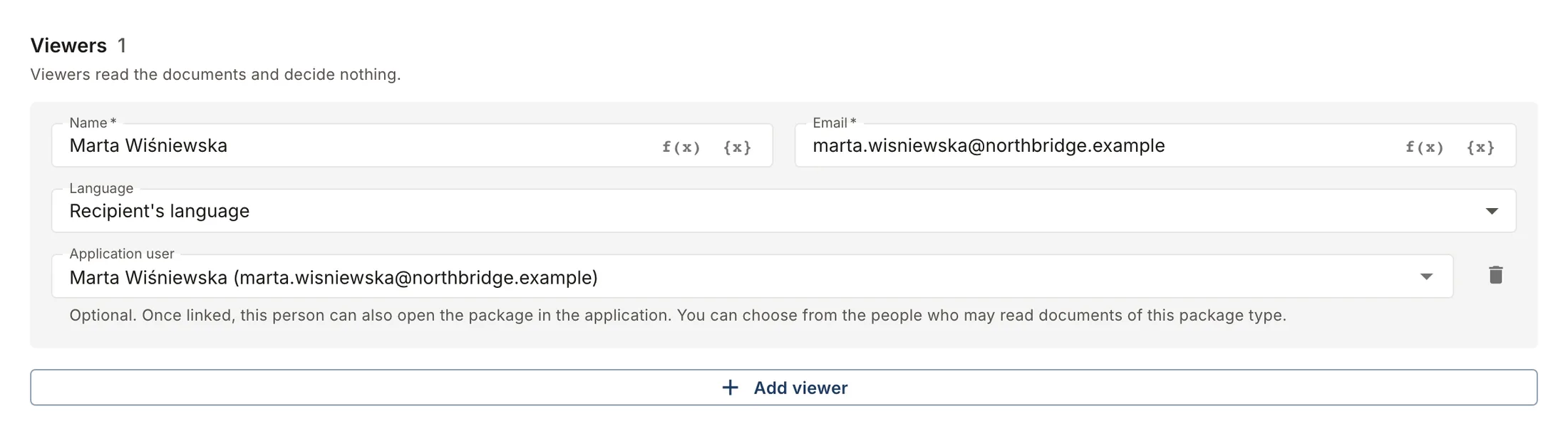
Viewers read the package and sign nothing. Northbridge adds its compliance officer here. Each viewer is emailed a link of their own when the package is created, so this tab needs the organization’s email configuration. Without one, the tab warns you and the step would fail. Click Add viewer for each person.
| Field | What it does |
|---|---|
| Name | Supports variables. |
| Where the link goes. Supports variables. An address that renders empty or invalid stops the run. | |
| Language | Recipient’s language (default), or the language of the emails to this viewer. |
| Application user | Optional. Linked, they can also open the package in the app. You choose from the people who may read documents of the package’s type. Choosing somebody fills in an empty Name and Email for you. |
A viewer sees every document in the package, whatever Who sees which documents says. The same fixed address can’t be listed twice, and two variables that turn out to give the same address produce one link. You can add more viewers later on the package page.
Approvers
Section titled “Approvers”An approver reads the documents and decides whether they go on to the next steps. At most five. They sign nothing and add nothing to the PDF. See Parties, approvers and viewers.
Who acts after whom: people in one step act at the same time, and each step waits for the one before. Turning it off asks everybody at once, unless there is an approver. See Signing order.
Delivery
Section titled “Delivery”Deadline and notifications
Section titled “Deadline and notifications”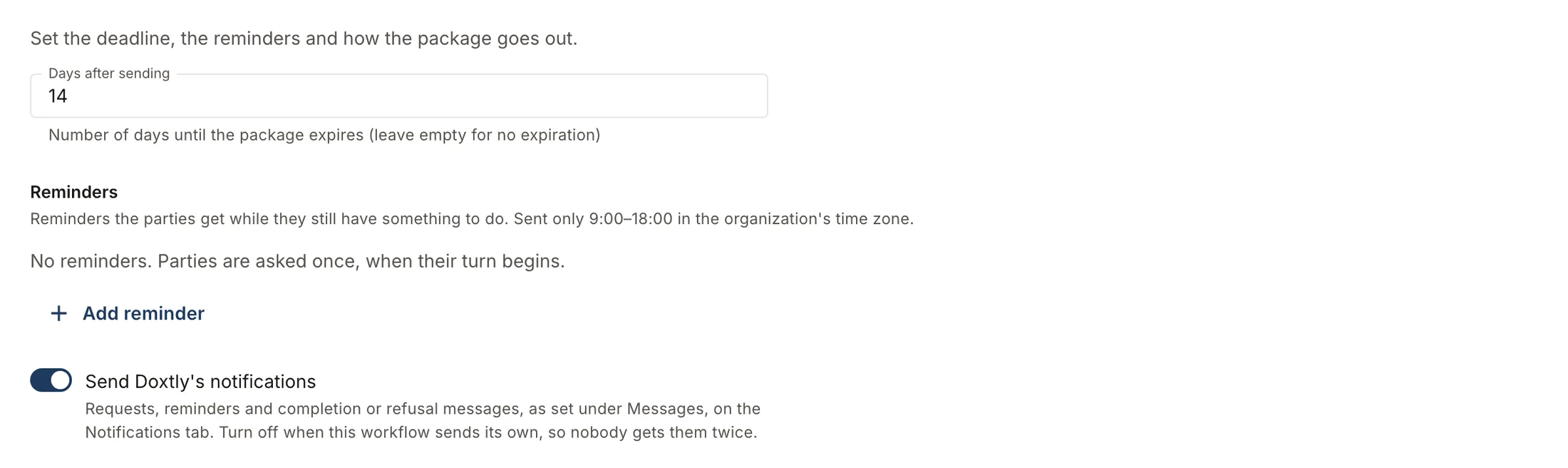
| Field | Values | What it does |
|---|---|---|
| Send Doxtly’s notifications | On (default), off | Requests, reminders and completion or refusal messages. Turn it off when the workflow writes its own, so nobody gets two. |
| Days after sending | A whole number, or empty | Days from the package’s creation until it expires. Empty, or 0, means it never does. See Deadlines. |
Reminders
Section titled “Reminders”What reminds the parties who are still to act, up to five reminders. Each goes a number of days after sending or before the deadline, optionally repeated, and either as the party was asked or by a channel, message and language of its own. See Reminders and deadlines.
Immediate signing
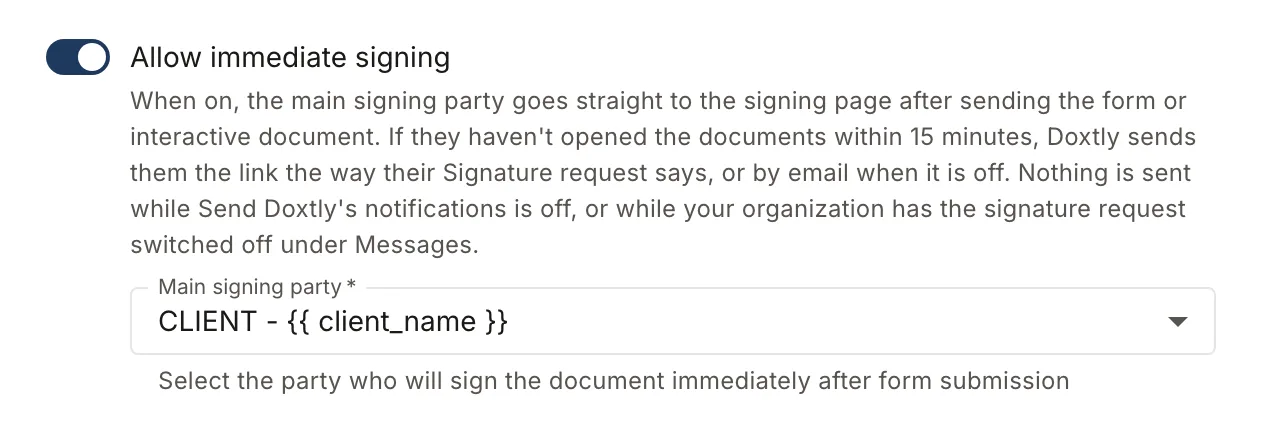
Section titled “Immediate signing”Turn on Allow immediate signing when the person filling in a form or an interactive document should sign straight away, without going to their inbox. See Signing right after a form.
Choosing how signers are checked
Section titled “Choosing how signers are checked”The check is set per party in their row on People, under How this party signs: Verification under How this party signs.
| Method | What the signer does | Needs |
|---|---|---|
| None | Nothing extra. Holding the link is the check. | Nothing. |
| Code by email | Types a six-digit code sent to their email. | An email address, and the organization’s email configuration. |
| Code by SMS | Types a code sent by SMS. | A phone number, and an SMS integration. |
| Code by WhatsApp | Types a code sent by WhatsApp. | A phone number, and a WhatsApp integration. |
| Access password | Types a password you gave them. | At least six characters, passed on by you. |
| Identity document and selfie | Shows an identity document and takes a selfie on Stripe’s page (more). | A paid plan with a payment method, and identity checks turned on in Subscription. Paid per attempt. |
| The organization’s default | Whatever your organization requires of every package, and nothing beyond the link when it requires nothing. | Whatever that method needs. |
The method is settled when the package is created. Changing the step later doesn’t touch packages already out.
A code protects reading the documents as well as signing and refusing: through a link nothing of the package shows until the code is entered, so somebody holding a forwarded link can’t read the documents, sign them or decline in the party’s name. Codes and their limits are explained in The signing experience.
A code by SMS or WhatsApp is the stronger choice, because the link usually travels by email: anyone who gets hold of the email still lacks the phone. SMS and WhatsApp messages may cost you money with your provider.
Getting the link to people
Section titled “Getting the link to people”Doxtly asks them
Section titled “Doxtly asks them”By default, Doxtly asks each party to sign when their turn begins, with your organization’s default message, by the channel set for the signature request under Notifications: email, unless you change it. Choose another channel, message or language under Signature request, per party.
By email or SMS from the workflow
Section titled “By email or SMS from the workflow”With a party’s Signature request turned off, you deliver the link yourself. The Create documents step adds each party to the run’s data, and later steps can use their details, among them the signing link. It is filled in only for those parties: a link sent before a party’s turn would open only the waiting page.
{{ _recipients.CLIENT.signingUrl }}{{ _recipients.PARTNER.signingUrl }}In the variable picker these appear as CLIENT – signing link, next to the party’s full name, email address and phone number.
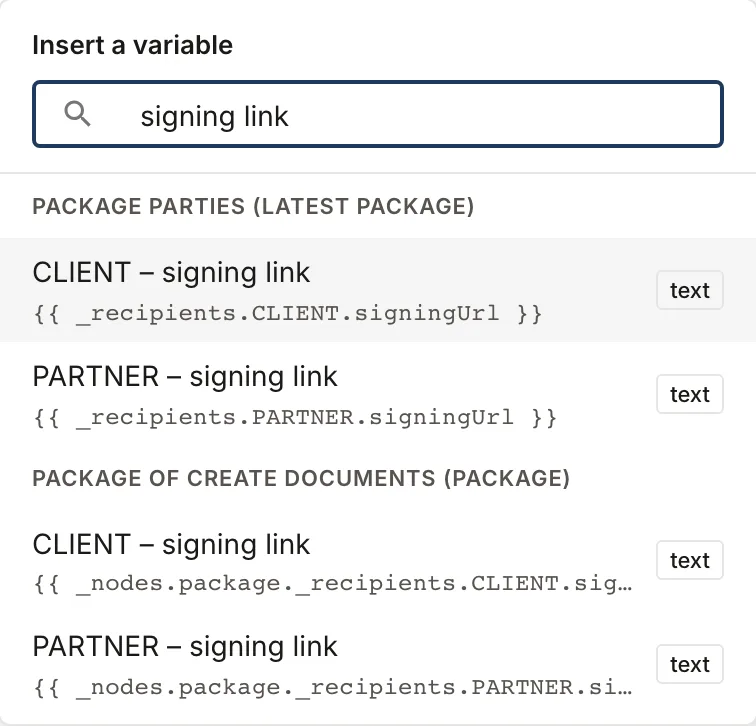
The usual pattern is one Send email step per party, right after Create documents:
- Recipient email address:
{{ _recipients.CLIENT.email }} - An email template with a button whose address is
{{ _recipients.CLIENT.signingUrl }}
Writing your own message means it comes in your voice and your branding. A Send SMS or Send WhatsApp step can carry the same link for a party you know only by phone. Several Create documents steps in one workflow? _recipients holds the latest package’s parties. To reach a specific one, go through the step’s id: {{ _nodes.contract._recipients.CLIENT.signingUrl }}. See Data and variables.
A signing link is personal: it is part of the proof of who signed. That is why the app never displays it, and why the archived copy of an email under Sent emails shows the link with its secret part replaced by [redacted].
In person
Section titled “In person”For a party who is with you, turn on Signs in person – do not send an invitation on their row and hand them your device when their turn comes. No link, SMS or reminder goes out. See In-person signing.
In the app
Section titled “In the app”A party who is a user of your organization doesn’t need a link at all. The package appears in their Documents list and under Waiting for you on their dashboard, and they sign inside Doxtly. Doxtly writes to them as their Signature request says, so if you’ve turned that off and want them to know right away, add an email step for them too.
Signing right after a form
Section titled “Signing right after a form”With Allow immediate signing on, the person who just sent the form or interactive document waits a moment and lands on the signing page. A training company uses this for enrollment: fill in the form, sign the terms, done, all in one sitting.
| Field | What it does |
|---|---|
| Allow immediate signing | Hands the person who submitted to the signing page. |
| Main signing party | Which party that person is. Required once Allow immediate signing is on. |
The rules:
- The switch is off unless the workflow starts when a form or an interactive document is sent. No other trigger leaves somebody waiting for a page.
- Only one Create documents step in a workflow can do this. If another has it on, turn it off there first.
- The main party must be sure to take part, so a party named only conditionally can’t be chosen.
- The main party needs an email address, for when the page can’t take over. The designer tells you so before you save.
- The other parties still need their links delivered, as usual.
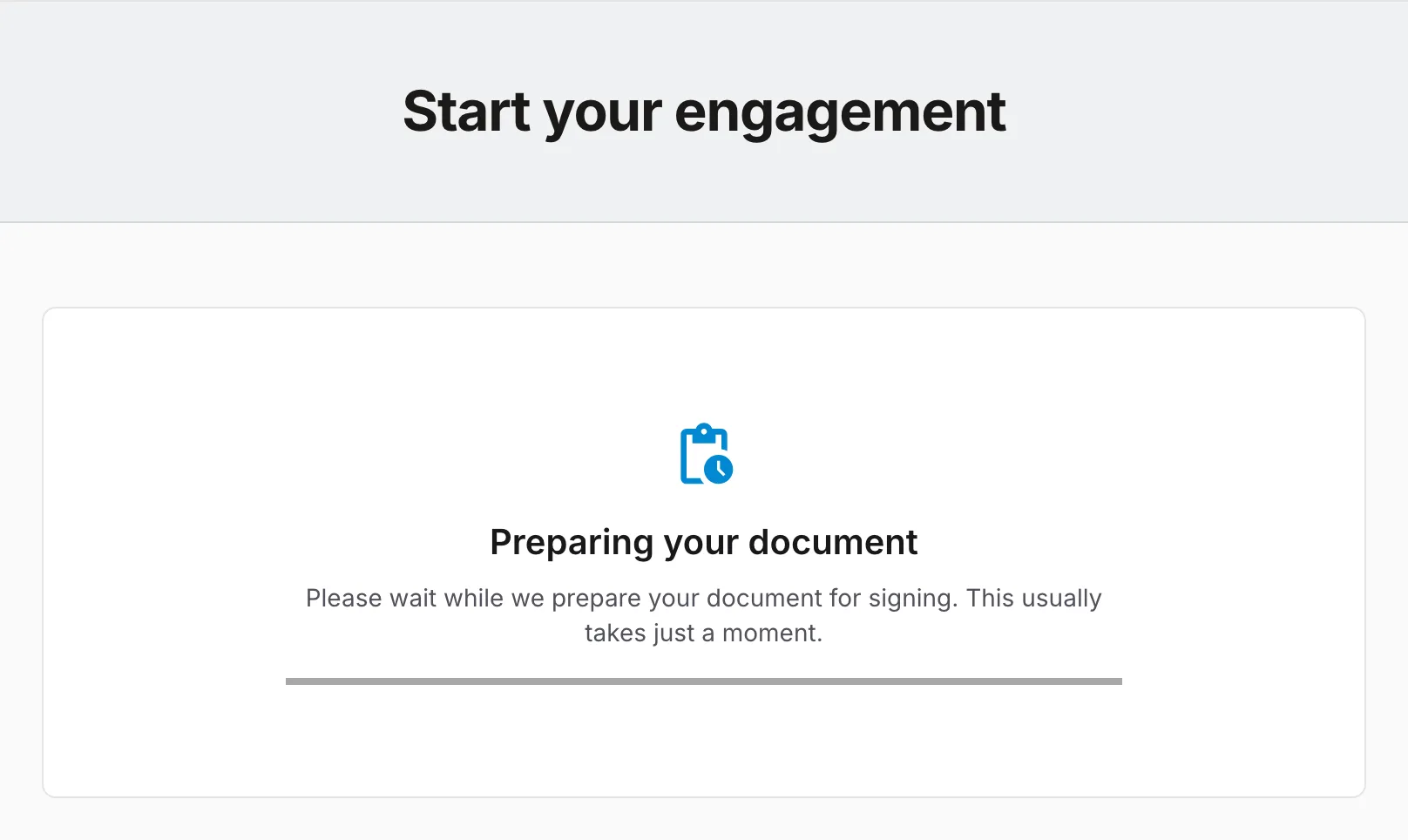
The visitor sees Preparing your document while the workflow runs, and then the signing page opens. A form embedded in another site shows Your document is ready to sign on the way, and if the page doesn’t open by itself, Continue to signing does the same.
What if something gets in the way?
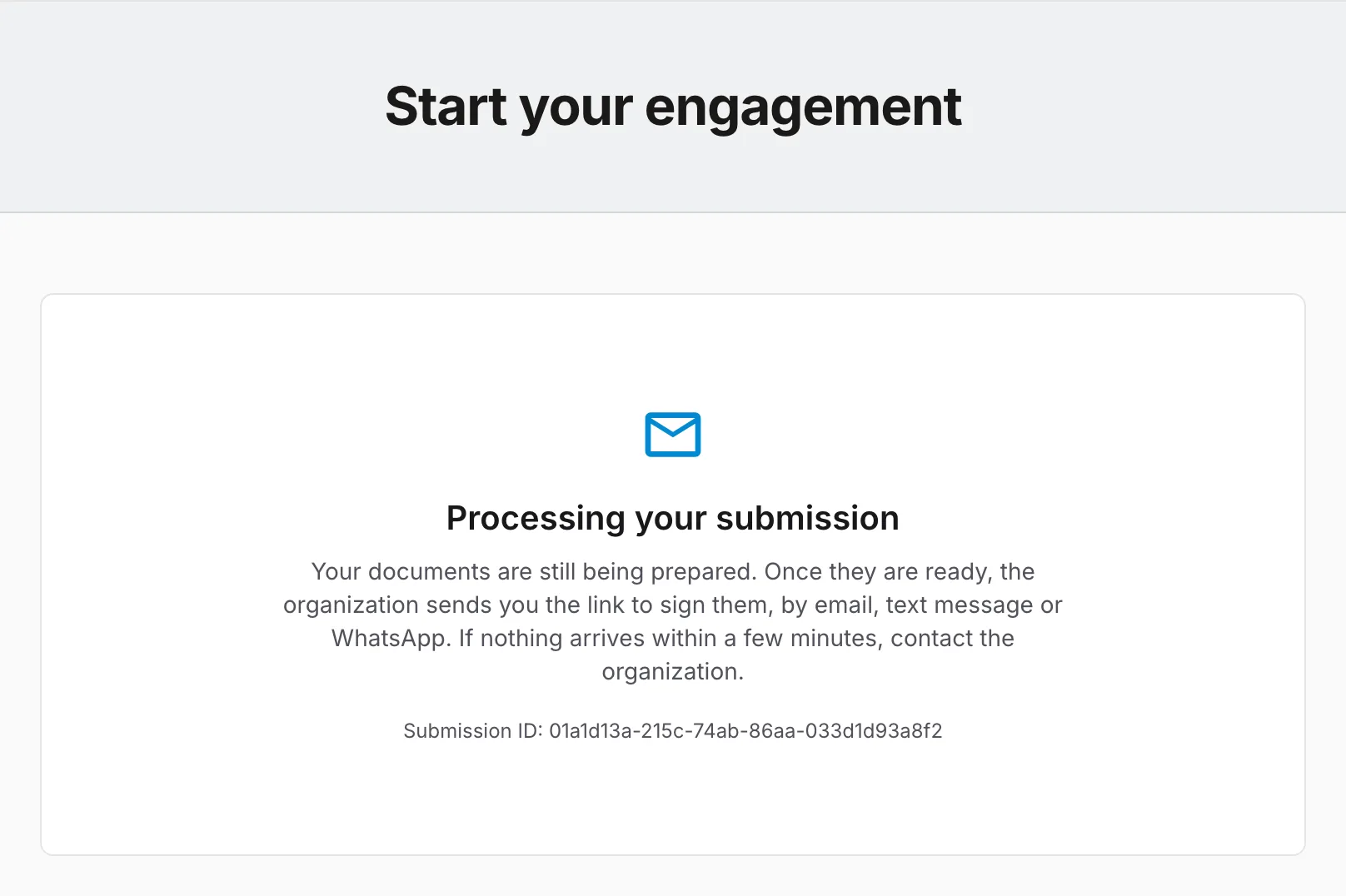
- The visitor leaves, or the documents take long. The session stays open for 15 minutes. If it closes and the main party hasn’t opened the documents, Doxtly sends them the signing link the way their Signature request says: as your organization’s default signature request, in their language, unless you chose another channel or template for the party; with the party’s request off, by email. Nothing is sent while the step’s Send Doxtly’s notifications is off, or while your organization has the signature request switched off: the link then reaches them only through a step of your own. The same goes for the two cases below. A visitor still on the page sees Processing your submission, which says the organization sends them the link to sign by email, text message or WhatsApp, and to contact it if nothing arrives within a few minutes.
- The workflow fails. The page reads Document preparation in progress and shows the submission’s ID, which is what to ask for if a client calls you. Doxtly tries again by itself where a retry can help. If it still fails, people who may view workflows get a Signing session failed notification, with a link to the failed run. If the documents were made after all, the main party is sent the link, and the notification says so. If the link could not go because the package sends no signature request, the notification says that instead: send it yourself with Send the signing link in the party’s menu on the package page.
- A submission is edited later. Nobody is waiting on the page then, so the main party is sent the link instead. When you edit a submission, the review also lets you withdraw packages made from the old data, so nobody signs them. The reason shows in the app and on the audit certificate, and nobody is notified of the withdrawal.
Deadlines
Section titled “Deadlines”Set the deadline as Days after sending on the Delivery tab, or on the package itself if you made it by hand. What it does to the package, how to move it and what happens once it passes: Reminders and deadlines.
Reminders
Section titled “Reminders”A package can remind the parties by itself, and you can nudge anyone at any time: Reminders and deadlines.
What happens after signing
Section titled “What happens after signing”| When | Doxtly does this |
|---|---|
| A party signs | Starts workflows with the A party signs trigger. You can limit that trigger to one party. |
| Every document is finished | Starts workflows with the The package is fully signed trigger and sends the notification Everyone signed: each party gets their own sealed PDFs attached, and each viewer every sealed PDF when they fit, with their own link, which goes on opening the signed documents. The audit log gets a Completion notice sent entry. The person responsible for the package gets a notification. |
| A party declines | Starts workflows with the A party declines to sign trigger. The run receives the reason, if one was given. The person responsible is notified, and when the refusal ends the package, the parties who signed or whose turn came get the Package refused message. |
These triggers listen to a document type. They run for packages of that type, made by a workflow or by hand, and the run receives the data the package was created with plus the values people typed while signing. See Triggers.
Each party’s documents go with the Everyone signed message, as attachments, only those that party may see. If they are too large for the mailbox (over 15 MB, or less on Outlook) the message carries a personal link instead, which works for 30 days; a party with only a phone number gets that link by text message when the row is set to SMS or WhatsApp. To send copies some other way, turn off Send the parties their signed documents on the package or document type, and build a workflow with Everyone has signed and a Send email step, or use the same trigger to file them in Google Drive or send them to your CRM.
If a workflow writes its own messages for a package, turn off Send Doxtly’s notifications on its Create documents step, so nobody gets two.
Cancelling
Section titled “Cancelling”To stop a package, choose Void package in the Documents list or on the package page, and give a Reason for voiding, which is required. It takes Manage documents. Documents not yet finished are voided, and a sealed or completed one stays as it is. Voiding can’t be undone, and links then show Package voided. Tell the parties is checked in the dialog, and sends the Package voided message to everybody who signed or whose turn has come; nobody further down the order hears. The reason stays out of the message unless you tick Include the reason in the message, because it is often internal.
- Run the workflow with your own address first, and sign as every party. It is the fastest way to catch a missing signature place.
- Keep each signing link in a message that says who you are and what the document is. People hesitate to click an unexpected link.
- Give every party an email address, even with SMS codes. The completion notice goes by the channel set under Notifications, email unless you change it, and a party it cannot reach gets none.
- Pick the level for the life of the document, not its importance: see Signature levels.