

Linking to forms and interactive documents
Sometimes a link does the job better than an embedded form: an “Enrol now” button in a course description, a menu item leading to your intake form, a sentence in a post. Interactive documents can only be linked to, because they have no embed code. With the plugin, you add a link the way you always do, type the name, and the address of its public page goes in. Nobody opens Doxtly to copy anything.
Available when: an access key is saved in the plugin's settings, with List forms to find forms, List interactive documents to find interactive documents, and List quizzes and List surveys to find quizzes and surveys
Anyone who can edit posts in WordPress can do this, contributors included. See The access key for the key’s permissions.
Where it works
Section titled “Where it works”| Editor | Where you can search | Where you can’t |
|---|---|---|
| Block editor | Links in text, Button blocks, Image links, and Custom Link items of a Navigation block | Navigation items of the Page or Post kind, which search only those |
| Classic editor | The link box and its Link options dialog | |
| Elementor | The Link field of a widget, such as Button, and the link box of Text Editor | The Link field of Atomic Elements, which runs its own search |
Where the search doesn’t reach, a link still works: copy the Public link from the form’s or document’s Share dialog and paste it. The same goes for Appearance → Menus, where a link is added under Custom Links.
In the block editor
Section titled “In the block editor”-
Select some text and click the link button, or press
Ctrl+K(⌘Kon a Mac). On a Button block, click its link button too. -
Type a few letters of the name.
-
Choose the result. A form says Doxtly form and an interactive document Interactive document, next to WordPress’s own Page and Post.
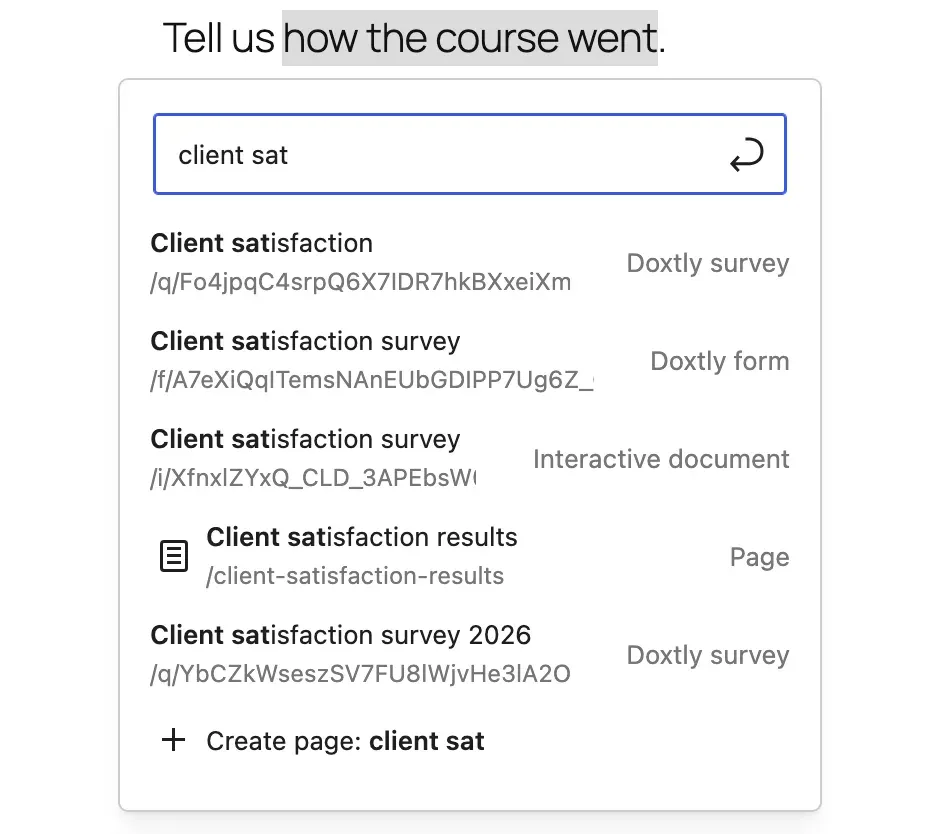
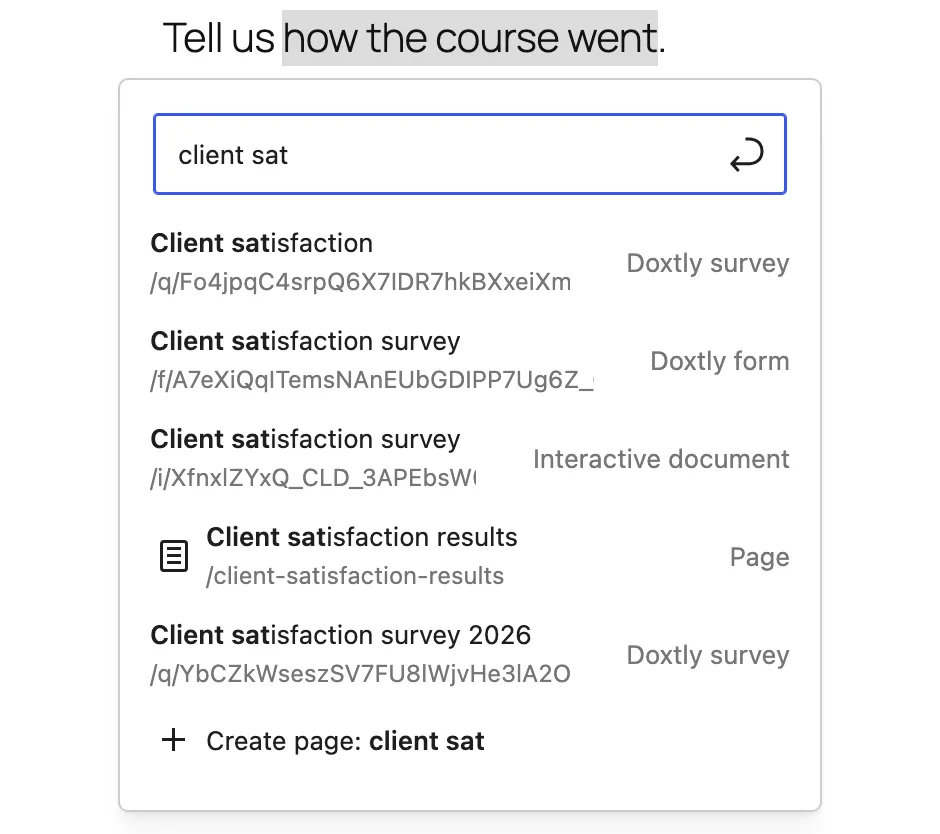
An address with /f/ in it is a form, and one with /i/ an interactive document.
An Image block’s link box shows only names. If a form and a document share a name, pick one and read the address that goes into the field, then confirm with Enter.
In the classic editor
Section titled “In the classic editor”-
Select some text and click the Insert/edit link button.
-
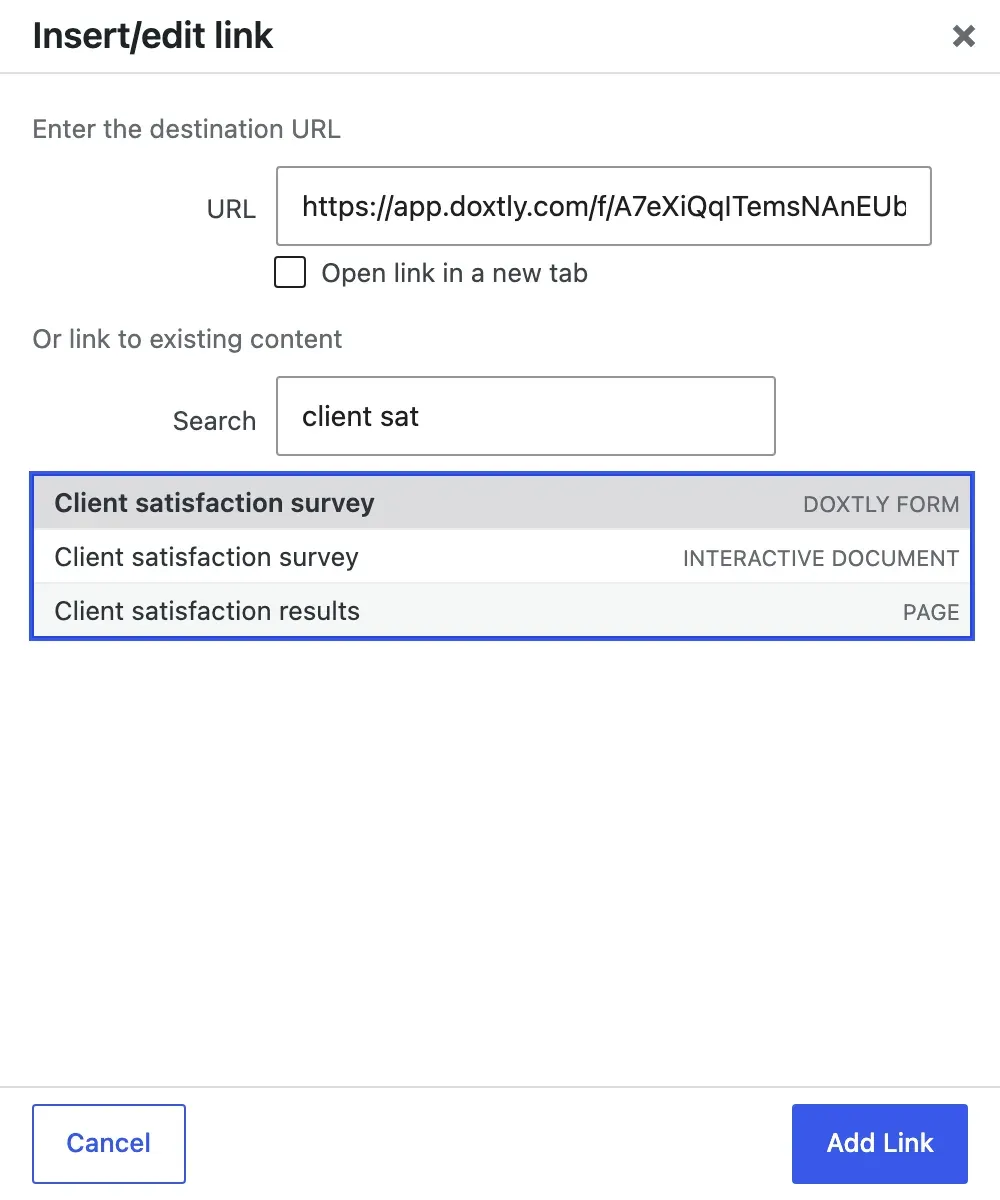
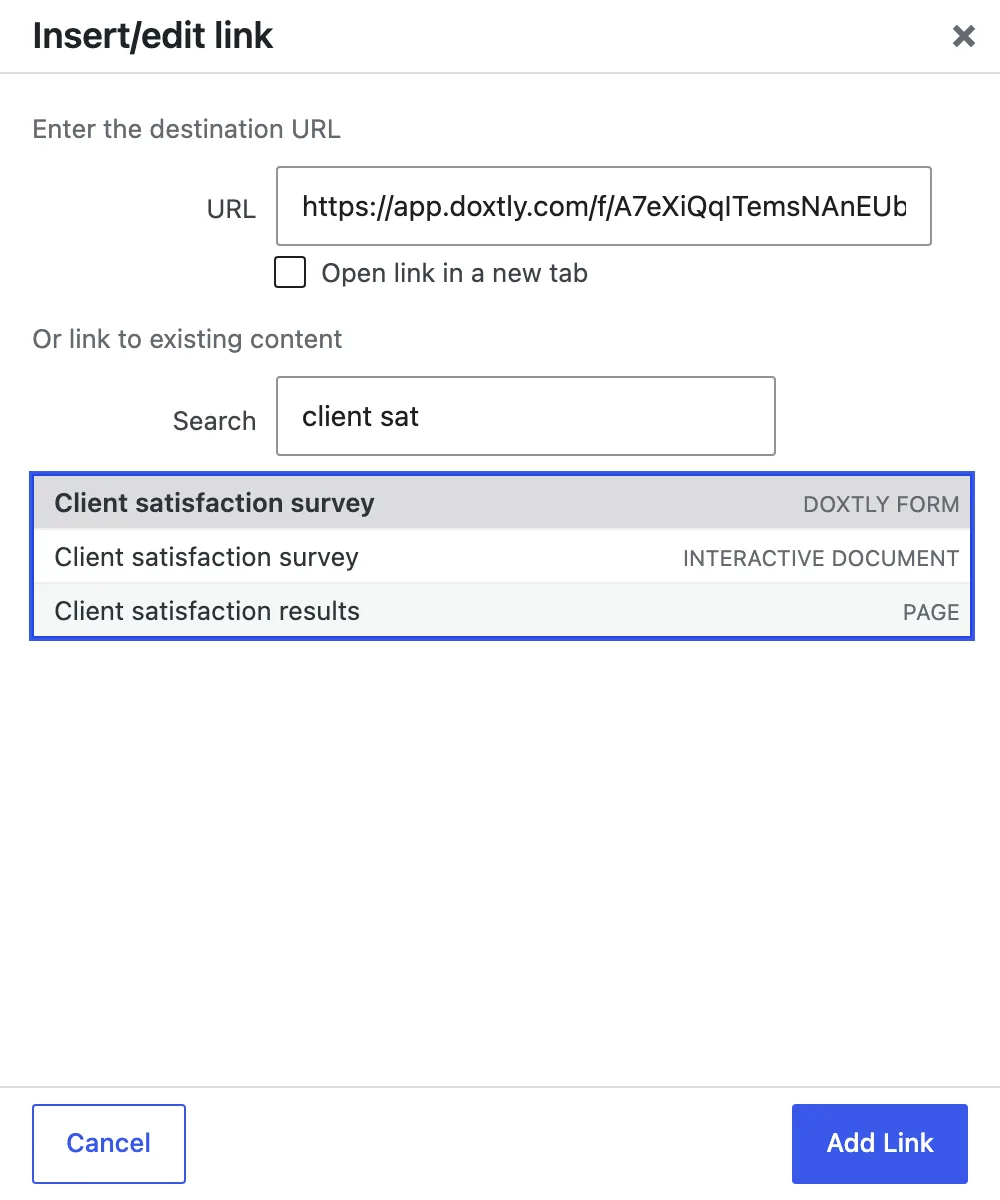
Type a few letters of the name in the box. To see the labels in a roomier list, click the Link options cog and use Search there.
-
Choose the result, then click Add Link, or the apply arrow in the small box.
In Elementor
Section titled “In Elementor”Available when: Elementor is installed and active
-
In the widget’s settings, click the Link field. A Button starts with
#in it, so clear that first. -
Type a few letters of the name.
-
Choose the result.
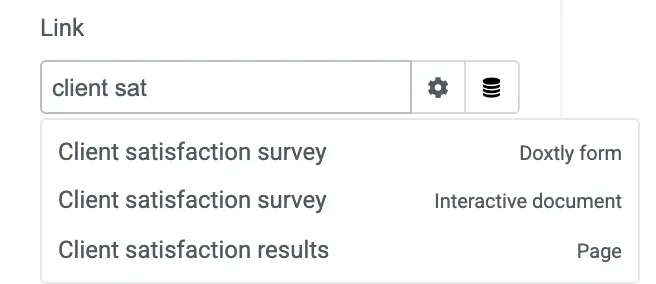
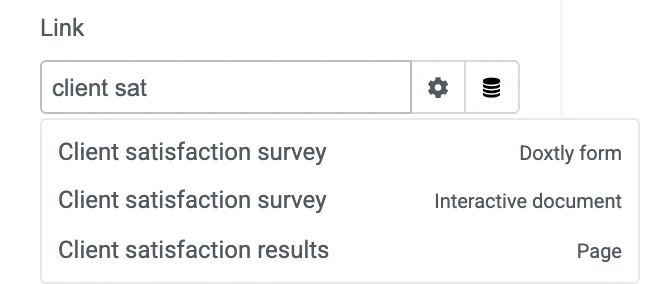
In a Text Editor widget, the link box works as it does in the classic editor.
The elements in the Atomic Elements group of Elementor’s panel have a Link field of their own, which looks only through your site’s pages and posts. Paste the address there.
What the search finds
Section titled “What the search finds”- Only what is Active in Doxtly. A form or a document that is switched off is not offered, because its page would show nothing.
- Forms, interactive documents, quizzes and surveys. A quiz is labelled Doxtly quiz and a survey Doxtly survey, and the link leads to its public page (
/q/). To show one on the page instead of linking to it, place it. - The name in any case, with or without accents:
lodzandŁÓDŹboth find “Łódź”. Every word you type has to be in the name, in any order. - At most ten results from Doxtly, those starting with what you typed first. If you don’t see yours, type more of the name.
- Changes within two minutes, or straight away if you save the settings: what you just activated turns up, and what you just switched off drops out.
Two forms can have the same name. The block editor shows the address of each. In the classic editor and Elementor, which show no address, the label adds the last eight characters of the ID, such as Doxtly form · 1cb8ad39. Those are the last characters of the form’s address in Doxtly.
What goes on your page
Section titled “What goes on your page”An ordinary link to the public page: https://app.doxtly.com/f/… for a form, https://app.doxtly.com/i/… for an interactive document. The address starts with your Application URL, so an organization with a subdomain gets https://northbridge.app.doxtly.com/f/… once that’s saved in the settings.
Because it’s a plain link, it stays where you put it. It works without the plugin and without the access key, and it adds no script to your pages. A link you added before changing the Application URL keeps the old address.
Like any link, it opens in the same tab unless you change that in the link’s options: Open in new tab in the block editor, Open link in a new tab in the classic editor, and Open in new window under the cog in Elementor. To carry something along, add link parameters to the address by hand, for example ?language=pl.
What a link needs
Section titled “What a link needs”The link leads to the same page as the Public link in Doxtly, so the same rules apply.
| In Doxtly | What the visitor gets | What to do |
|---|---|---|
| The form or document is Active | The page | Nothing |
| It was deactivated or deleted after you linked to it | A message that it can’t be found. WordPress doesn’t warn you about it, as the block does for an embedded form. | Activate it, or change the link. |
| It has a password | A password prompt | Tell people the password. It doesn’t travel with the link. |
| It uses Validate request origin | The page only if your Doxtly address is among the allowed origins | Add that address, or use the block or widget for a form. For a document, see its security settings. |
| It has a required parameter | Missing required parameters | Add the parameter to the link’s address. |
When Doxtly can’t be reached
Section titled “When Doxtly can’t be reached”Your own pages and posts keep turning up as before. Without a key, with a key that lacks a permission, or while WordPress can’t reach Doxtly, the search shows nothing from Doxtly, with no error. A key with only List forms finds forms, and one with only List interactive documents finds documents. If Doxtly doesn’t answer, the search waits three seconds at most and then leaves it alone for a minute, so typing stays quick. Troubleshooting lists what to check.