

Linking to forms and interactive documents
Sometimes a link does the job better than an embedded form: an “Enrol now” line in a course description, a sentence on a service page, a link in a CMS block. Interactive documents can only be linked to, because they have no embed code. With the Doxtly Link widget you type the name, and a link to the public page goes in. Nobody opens Doxtly to copy anything.
Available when: an access key is saved in the module's settings, with List forms to find forms, List interactive documents to find interactive documents, and List quizzes and List surveys to find quizzes and surveys
The admin user’s role also needs Choose forms and links in the editor. See Who can do what in Magento and The access key for the key’s permissions.
Where it works
Section titled “Where it works”The link search lives in the widget, so it works wherever Magento offers Insert Widget: Text and HTML Code in Page Builder, the plain editor, and the descriptions of products and categories. As a widget instance, it puts the link into a part of the layout.
Magento’s own link button in the editor’s toolbar does not search Doxtly. In the top menu, and anywhere else that has no Insert Widget, a link still works: copy the Public link from the form’s or document’s Share dialog and paste it.
Adding a link
Section titled “Adding a link”-
Put the cursor where the link should go and open Insert Widget.
-
Under Widget Type, choose Doxtly Link, then click Search by name.
-
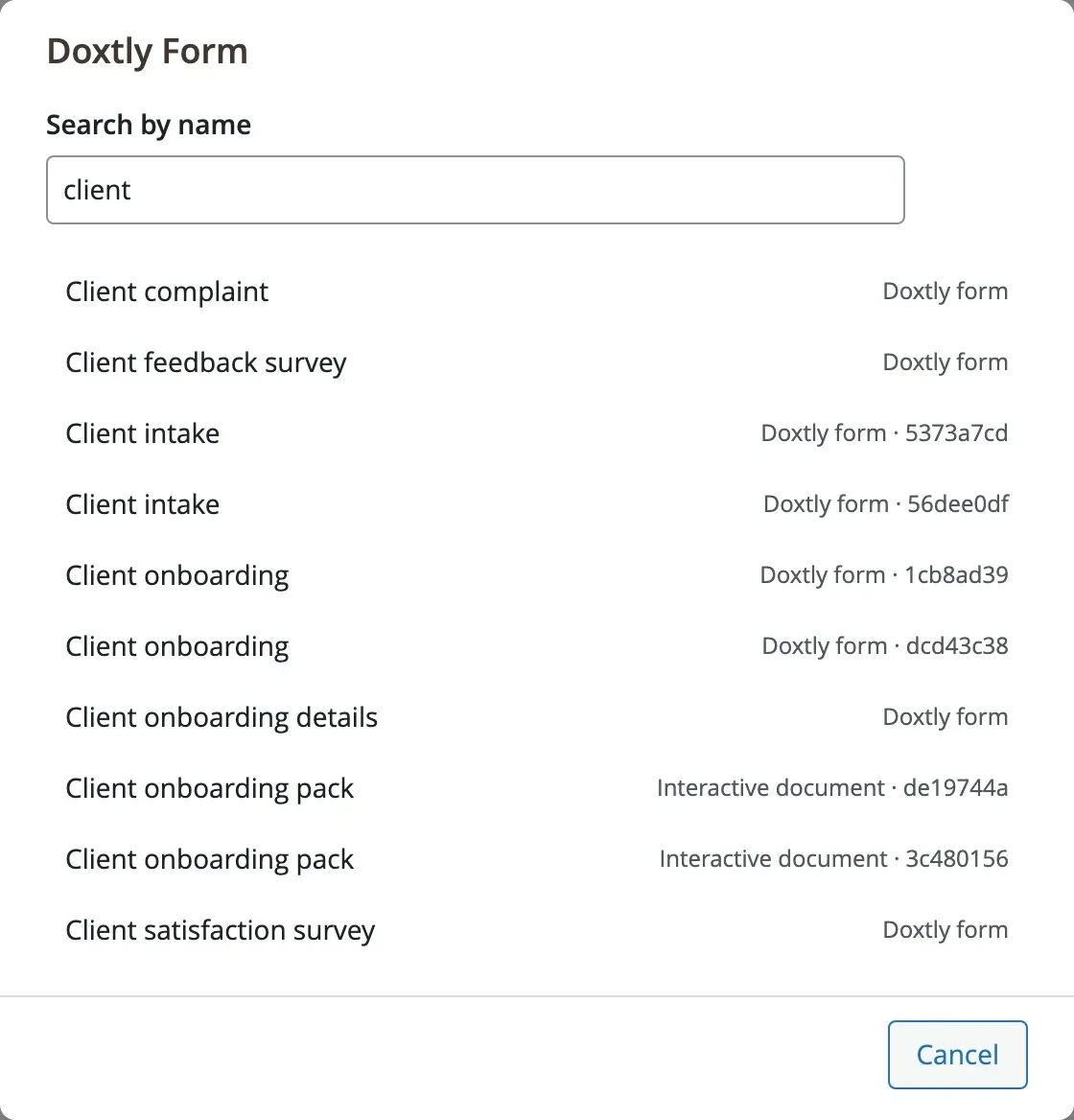
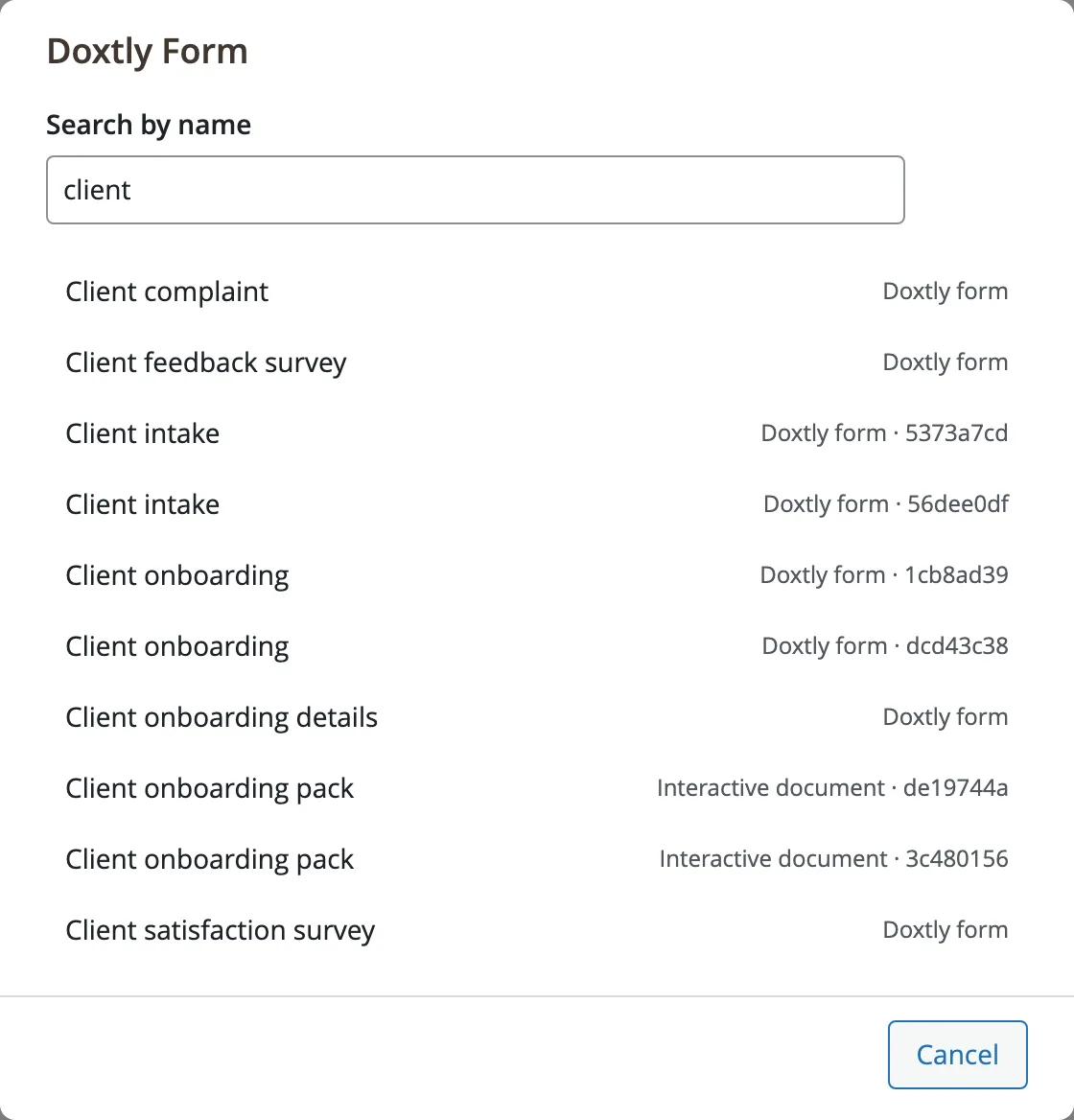
Type a few letters of the name. A form says Doxtly form and an interactive document Interactive document.
-
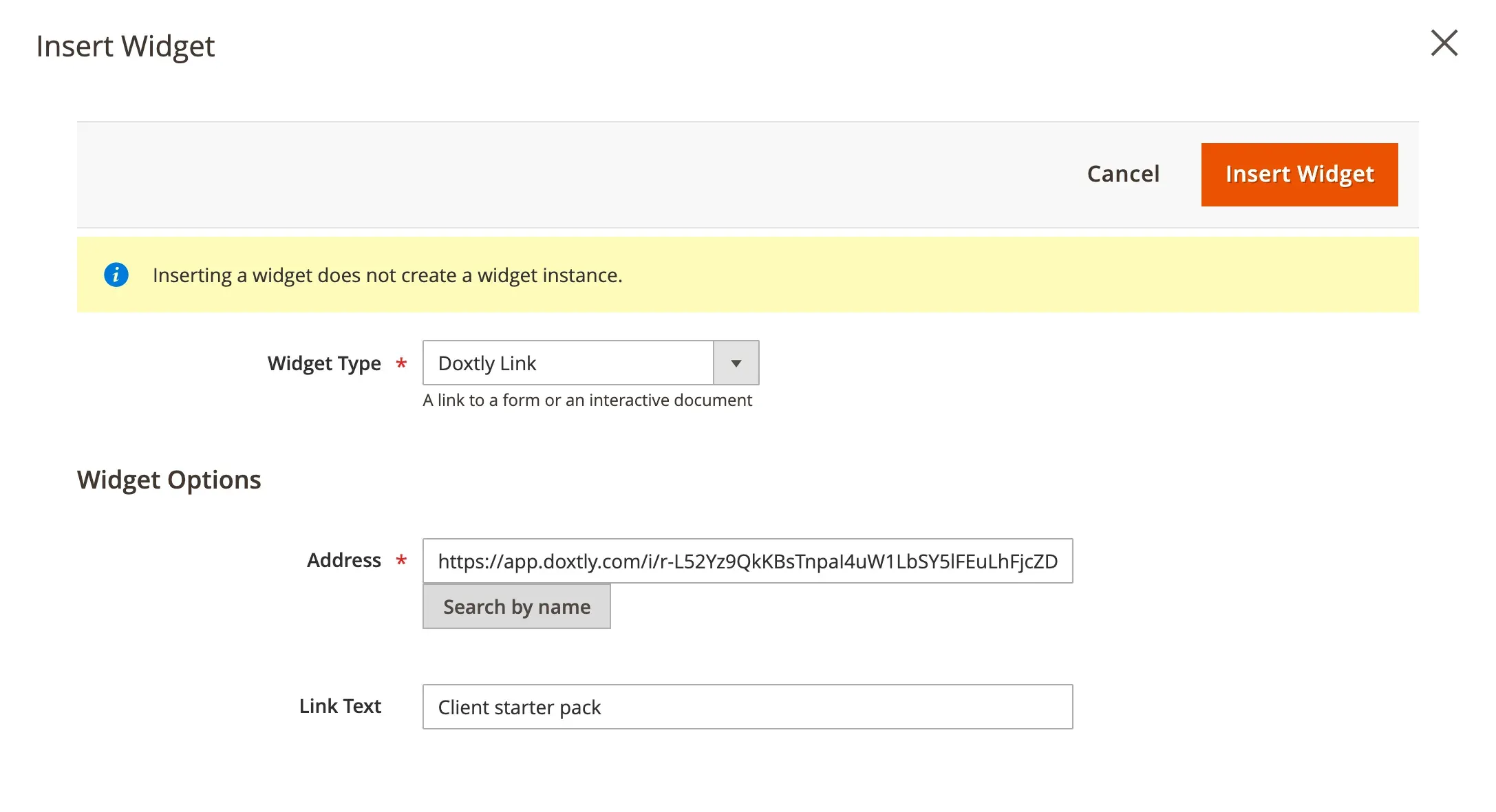
Click the result. Its address goes into Address, and its name into Link Text unless you have written one there.
-
Change Link Text if you like, and click Insert Widget.
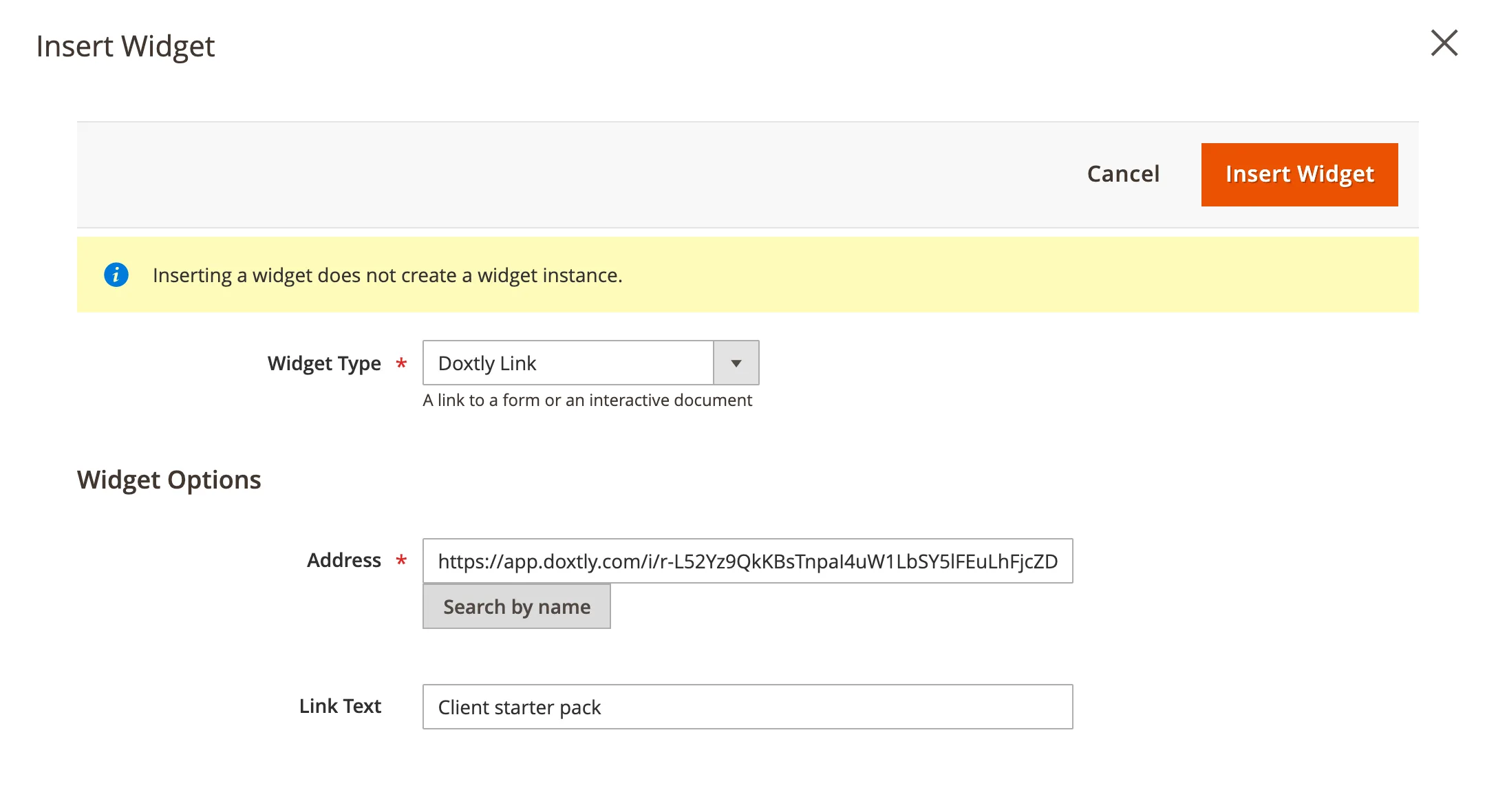
An address with /f/ in it is a form, and one with /i/ an interactive document. You can also paste an address into Address yourself, as long as it starts with http or https.
The link goes into the content as it is, with no widget around it.

As a widget instance
Section titled “As a widget instance”Doxtly Link is also on the list in Content → Elements → Widgets. It works like a form’s instance, and the link appears in the container you choose. Unlike a link in content, it is gone when you remove the module.
What the search finds
Section titled “What the search finds”- Only what is Active in Doxtly. A form or a document that is switched off is not offered, because its page would show nothing.
- Forms, interactive documents, quizzes and surveys. A quiz is labelled Doxtly quiz and a survey Doxtly survey, and the link leads to its public page (
/q/). To show one on the page instead of linking to it, place it. - The name in any case, with or without accents:
lodzandŁÓDŹboth find “Łódź”. Every word you type has to be in the name, in any order. It starts at two letters. - At most ten results from Doxtly, those starting with what you typed first. If you don’t see yours, type more of the name.
- Changes within two minutes, or straight away if you save the settings: what you just activated turns up, and what you just switched off drops out.
Two forms can have the same name. The label then adds the last eight characters of the ID, such as Doxtly form · 1cb8ad39. Those are the last characters of the form’s address in Doxtly.
What goes on your page
Section titled “What goes on your page”An ordinary link to the public page: https://app.doxtly.com/f/… for a form, https://app.doxtly.com/i/… for an interactive document. The address starts with your Application URL, so an organization with a subdomain gets https://northbridge.app.doxtly.com/f/… once that’s saved in the settings.
Because it’s a plain link, it stays where you put it. It works without the module and without the access key, and it adds no script to your pages. You edit it like any other link. A link you added before changing the Application URL keeps the old address.
Like any link, it opens in the same tab unless you change that with the editor’s link button. To carry something along, add link parameters to the address by hand, for example ?language=pl.
What a link needs
Section titled “What a link needs”The link leads to the same page as the Public link in Doxtly, so the same rules apply.
| In Doxtly | What the visitor gets | What to do |
|---|---|---|
| The form or document is Active | The page | Nothing |
| It was deactivated or deleted after you linked to it | A message that it can’t be found. Magento doesn’t warn you about it, as the widget does for an embedded form. | Activate it, or change the link. |
| It has a password | A password prompt | Tell people the password. It doesn’t travel with the link. |
| It uses Validate request origin | The page only if your Doxtly address is among the allowed origins | Add that address, or use the widget for a form. For a document, see its security settings. |
| It has a required parameter | Missing required parameters | Add the parameter to the link’s address. |
When Doxtly can’t be reached
Section titled “When Doxtly can’t be reached”Without a key, with a key that lacks a permission, or while Magento can’t reach Doxtly, the search says “Nothing found in Doxtly.” and shows no error. A key with only List forms finds forms, and one with only List interactive documents finds documents. If Doxtly doesn’t answer, the search waits three seconds at most and then leaves it alone for a minute, so typing stays quick. Troubleshooting lists what to check.