

Settings and connecting to Doxtly
The plugin has one settings page. It says where your Doxtly is and, if you want editors to pick forms from a list and find them when they add a link, holds the access key. Forms on your pages work without a key: it only changes how editors choose them.
Available when: the WordPress user may manage the site's settings, usually an administrator
Open Settings → Doxtly Forms, or click Settings under the plugin’s name in the list of plugins. WordPress keeps separate settings for each site of a multisite network.
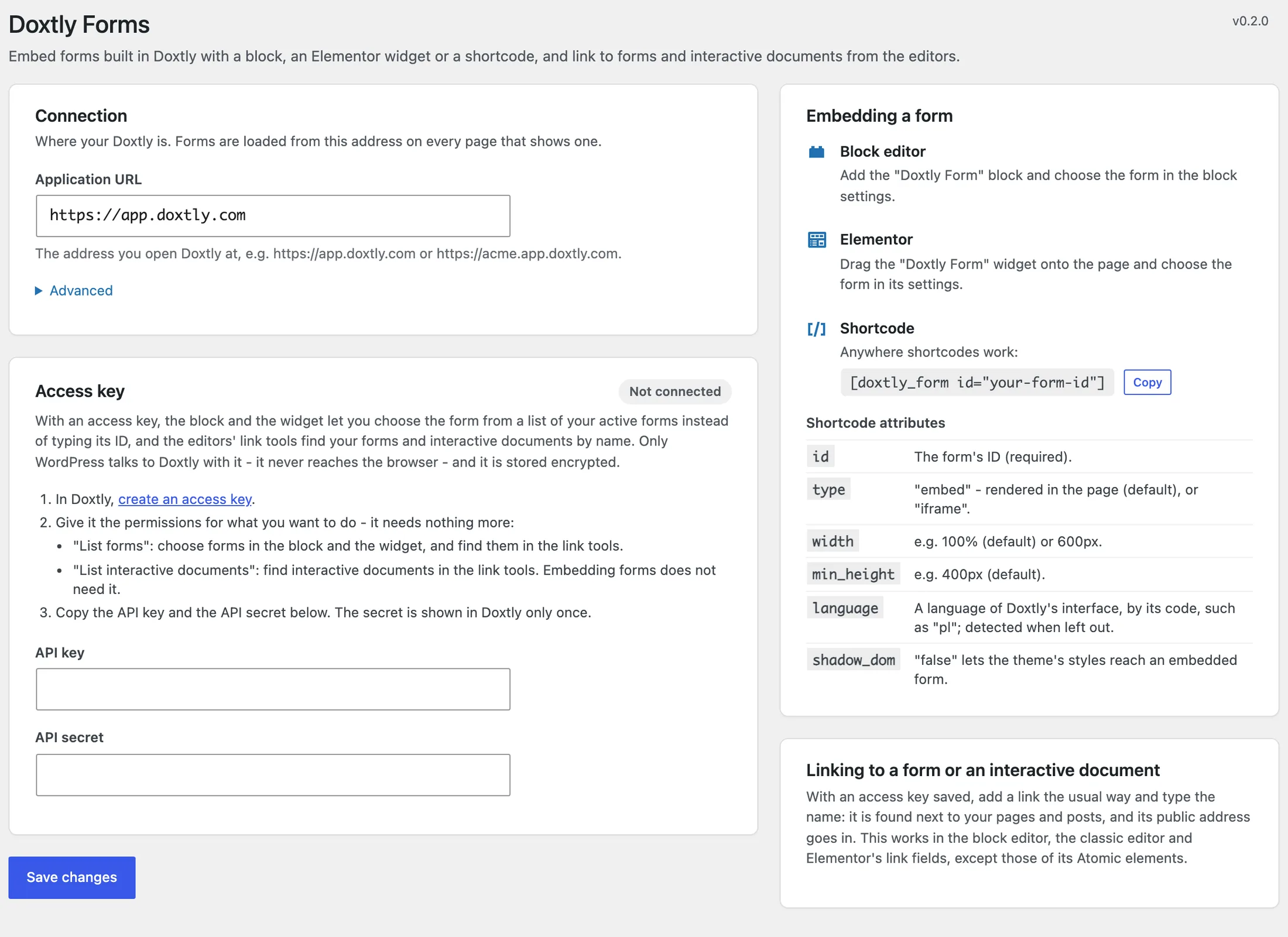
Connection
Section titled “Connection”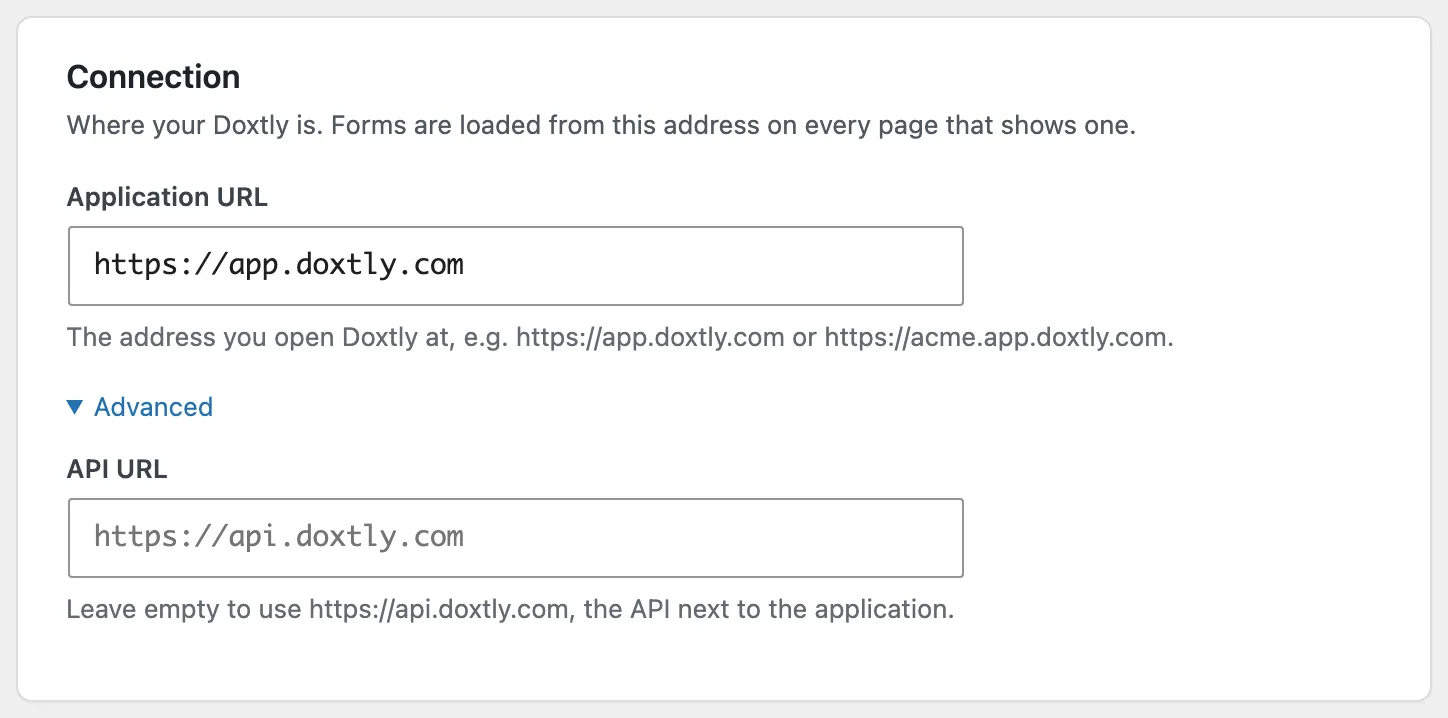
| Field | What it is for | Default |
|---|---|---|
| Application URL | The address you open Doxtly at, such as https://app.doxtly.com, or https://northbridge.app.doxtly.com if your organization has a subdomain. Every page with a form loads it from here. |
https://app.doxtly.com, also if you leave it empty |
| API URL (under Advanced) | Where WordPress reads the lists of forms and interactive documents. Leave it empty: the plugin takes the Application URL and turns its app part into api. |
Worked out from the Application URL |
API URL matters only if your Application URL has no app part in it. The plugin then opens Advanced by itself and says so. This field is used for the lists in the editors, not for showing forms to visitors. Links found in the link tools use the Application URL.
Both must be valid http or https addresses. A trailing slash is removed for you.
The access key
Section titled “The access key”An access key lets WordPress ask Doxtly what it can offer your editors. Without one, they type or paste a form’s ID, and the link tools find nothing in Doxtly. What a key gives depends on its permissions, and you choose only what you need:
| Permission | What editors get | Without it |
|---|---|---|
| List forms | A list of form names in the block and the widget, and your active forms in the link tools | Forms are entered by their ID and the link tools don’t find them |
| List interactive documents | Your active interactive documents in the link tools | Nothing changes for forms. Skip it if you only embed forms. |
| List quizzes, List surveys | A list of your active quizzes and surveys in the Doxtly Quiz or Survey block, and both in the link tools | Quizzes and surveys are placed by their token, and links to them are pasted |
| Read themes of public pages | A list of your Doxtly themes under Doxtly theme, wherever forms, quizzes and surveys are placed | The theme set in Doxtly is used, or a theme’s ID is typed |
Available when: your Doxtly role holds Manage access keys, to create the key
Keys are part of every plan. A key belongs to the organization and not to a person, so it keeps working when a colleague leaves.
-
On the settings page, click create an access key. This opens the new key form in Doxtly, at the address you entered as the Application URL.
-
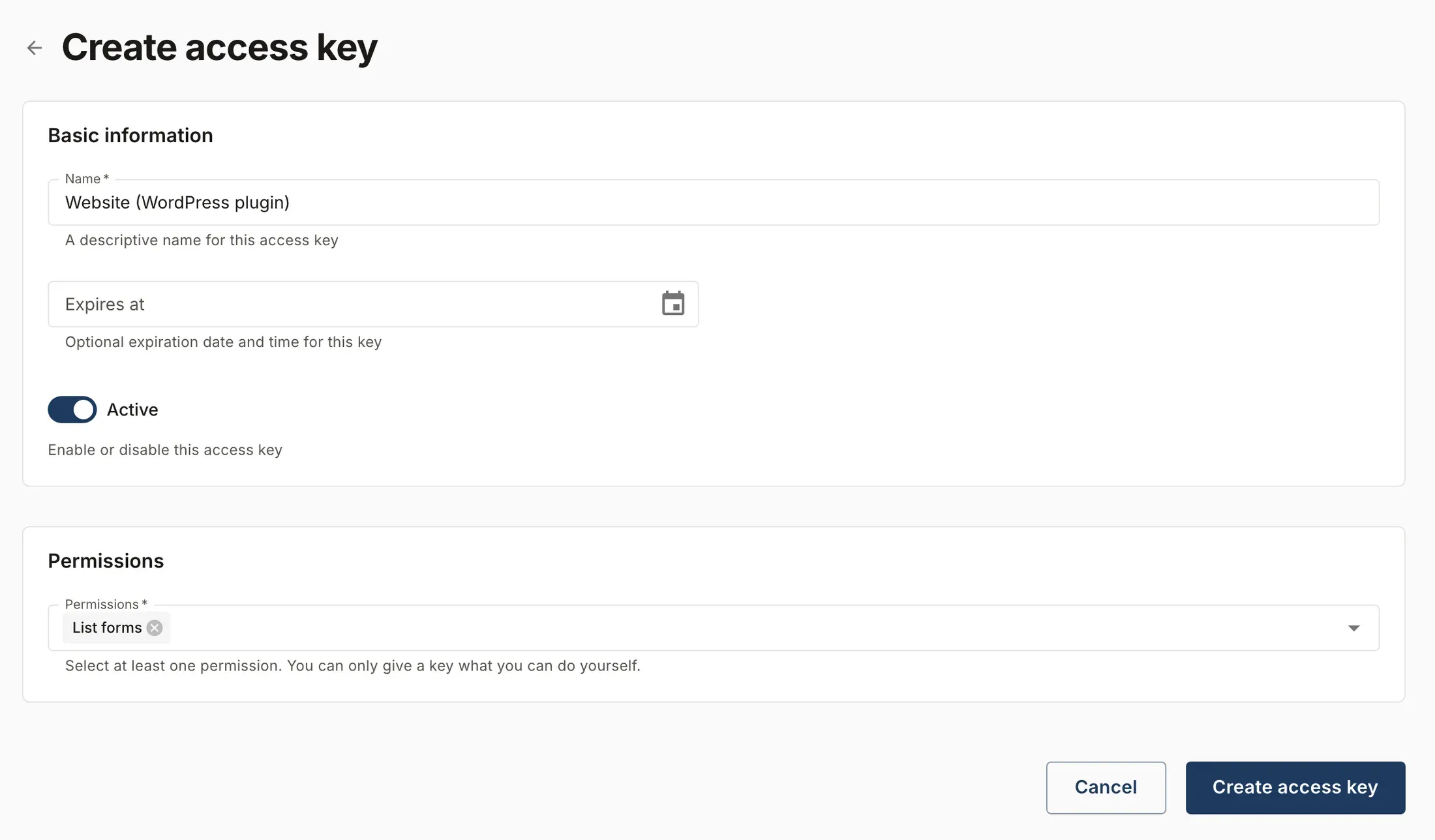
Give the key a name that says what it is for, such as “Website (WordPress plugin)”.
-
Under Permissions, choose List forms. To link to interactive documents as well, add List interactive documents, and for quizzes and surveys List quizzes and List surveys. The plugin needs no more. You can only give a key what your own role allows.
-
Click Create access key and copy the API key and the API secret. Doxtly shows the secret only once.
-
Back in WordPress, paste them into API key and API secret and click Save changes.
The page then checks the connection and tells you what the key can read.
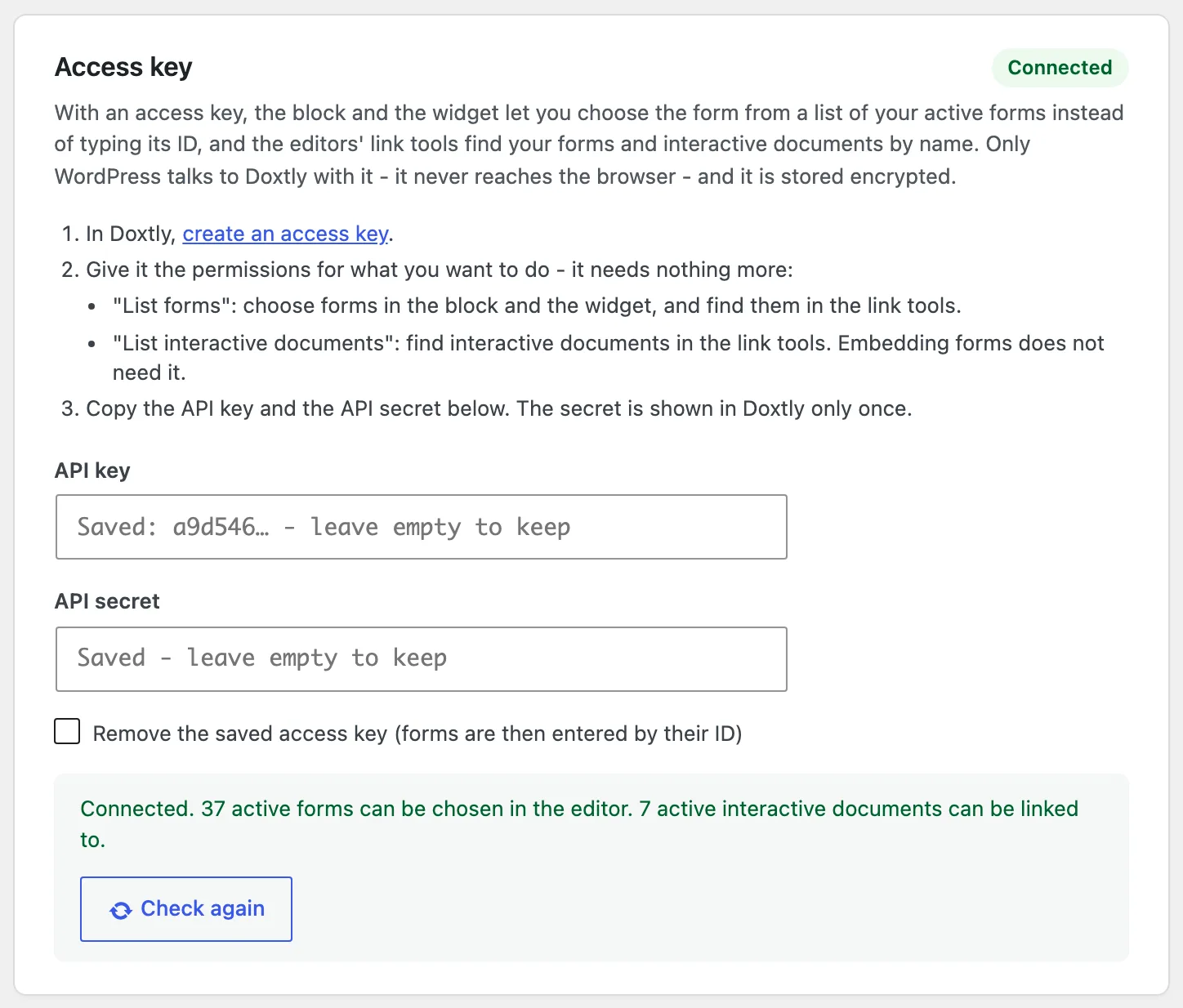
What you need to know about the saved key:
- Only WordPress uses it. It never reaches a visitor’s or an editor’s browser. Editors get names, IDs and links through your own site.
- It is stored encrypted, and the page never shows it again. You see its first few characters so that you can tell which key is saved.
- It can do nothing but read the lists, if you gave it only the permissions above.
- Leave a field empty when you save and the stored value stays. That is how you replace only the secret after rotating a key.
Check again repeats the test straight away, against Doxtly itself. Saving the settings forgets the lists held in WordPress, so the next look reads them afresh.
Status
Section titled “Status”The label beside Access key tells you where you stand.
| Label | What it means |
|---|---|
| Not connected | No key is saved. Editors enter forms by their ID. |
| Checking… | The page is reading the lists. |
| Connected | The list of forms was read. The message below it gives the number of active forms and of active interactive documents. If the key lacks List interactive documents, it says so. That is no fault: a site that only embeds forms needs nothing more. |
| Connected, without forms | The key reads interactive documents but lacks List forms, so forms are entered by their ID and the link tools don’t find them. |
| Connection failed | The list of forms could not be read. The message says why. See Troubleshooting. |
| Cannot be decrypted | The saved key no longer opens. See below. |
| Needs an encryption key | This site has nowhere safe to keep the key. See below. |
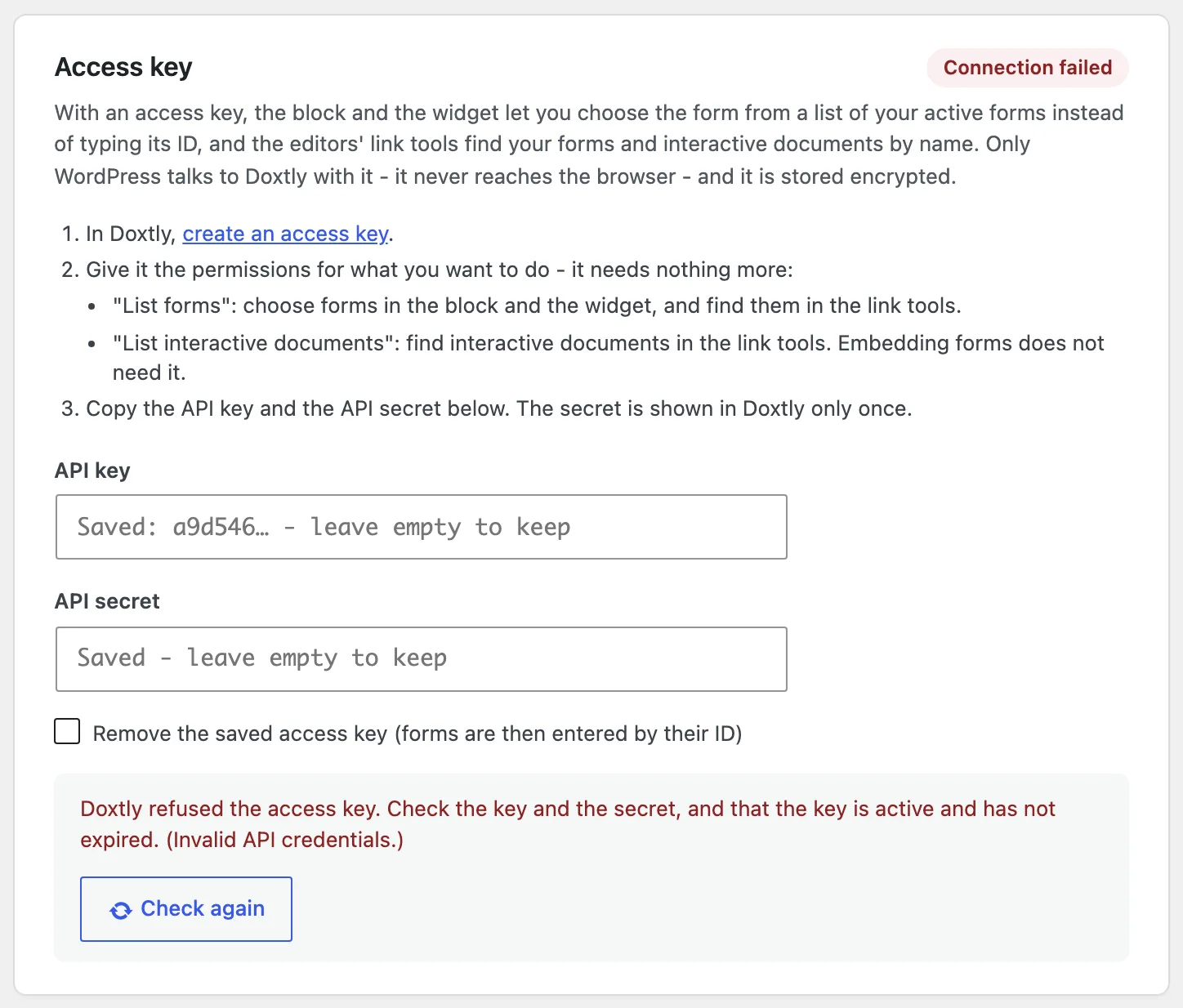
Where the encryption key comes from
Section titled “Where the encryption key comes from”WordPress encrypts the access key with a secret that lives outside its database, so a copy of the database alone does not give the key away. That secret is the value of DOXTLY_FORMS_ENCRYPTION_KEY if wp-config.php defines it, and otherwise your site’s LOGGED_IN_KEY and LOGGED_IN_SALT.
Most sites have those two set and never think about this. If wp-config.php sets neither of them, WordPress generates them and keeps them in the database, right beside the key they would protect. The plugin refuses that arrangement: the status reads Needs an encryption key, a warning explains why, and the two fields are disabled.
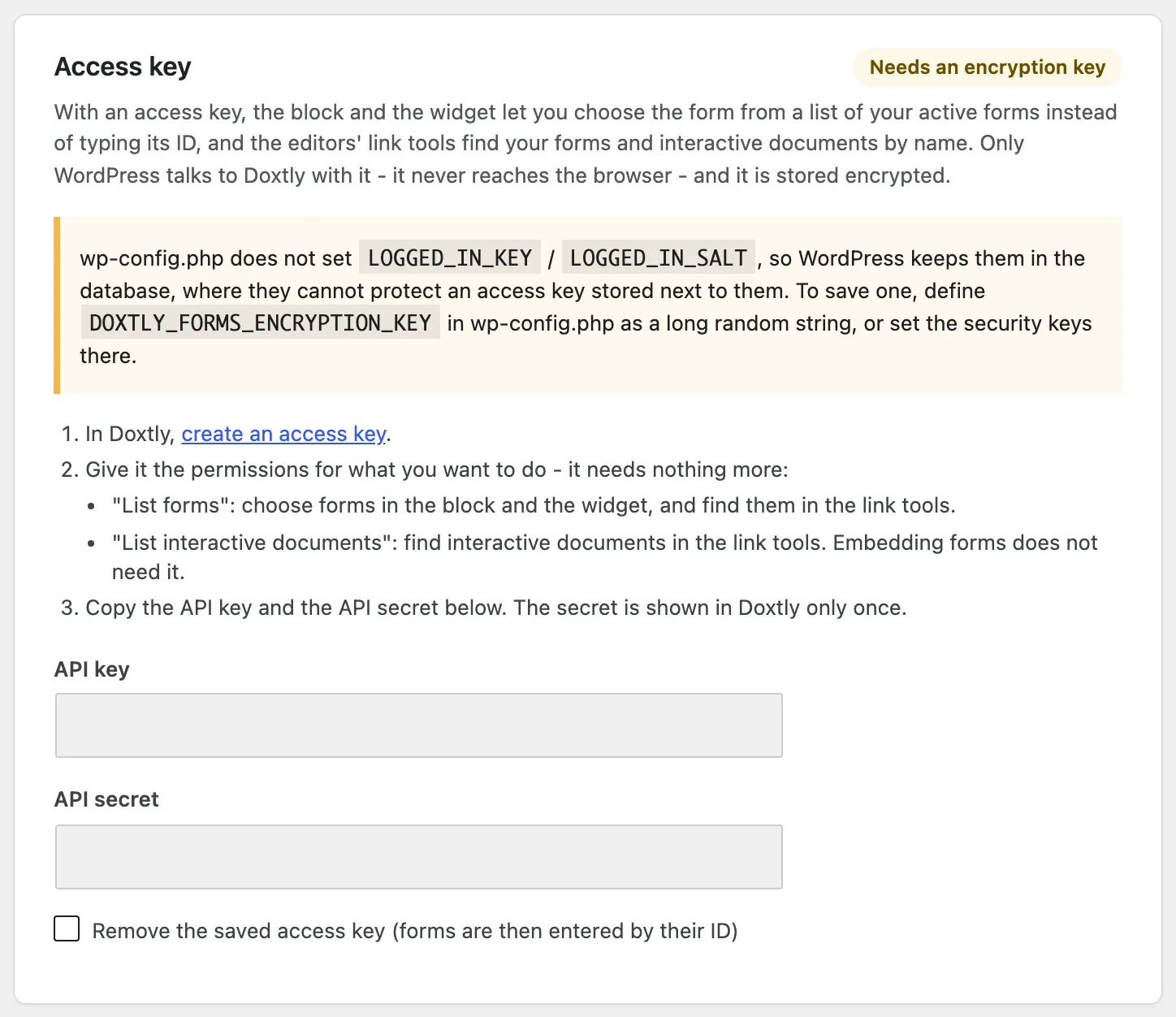
To fix it, add one line to wp-config.php, or ask whoever hosts your site to, and then enter the access key again:
define('DOXTLY_FORMS_ENCRYPTION_KEY', 'a-long-random-string-of-your-own');If the security keys change later, which some security plugins and hosts do on a schedule, the stored key can no longer be read. The status changes to Cannot be decrypted. Forms on your pages carry on working. Enter the key and the secret again, or set your own DOXTLY_FORMS_ENCRYPTION_KEY so that this cannot happen again.
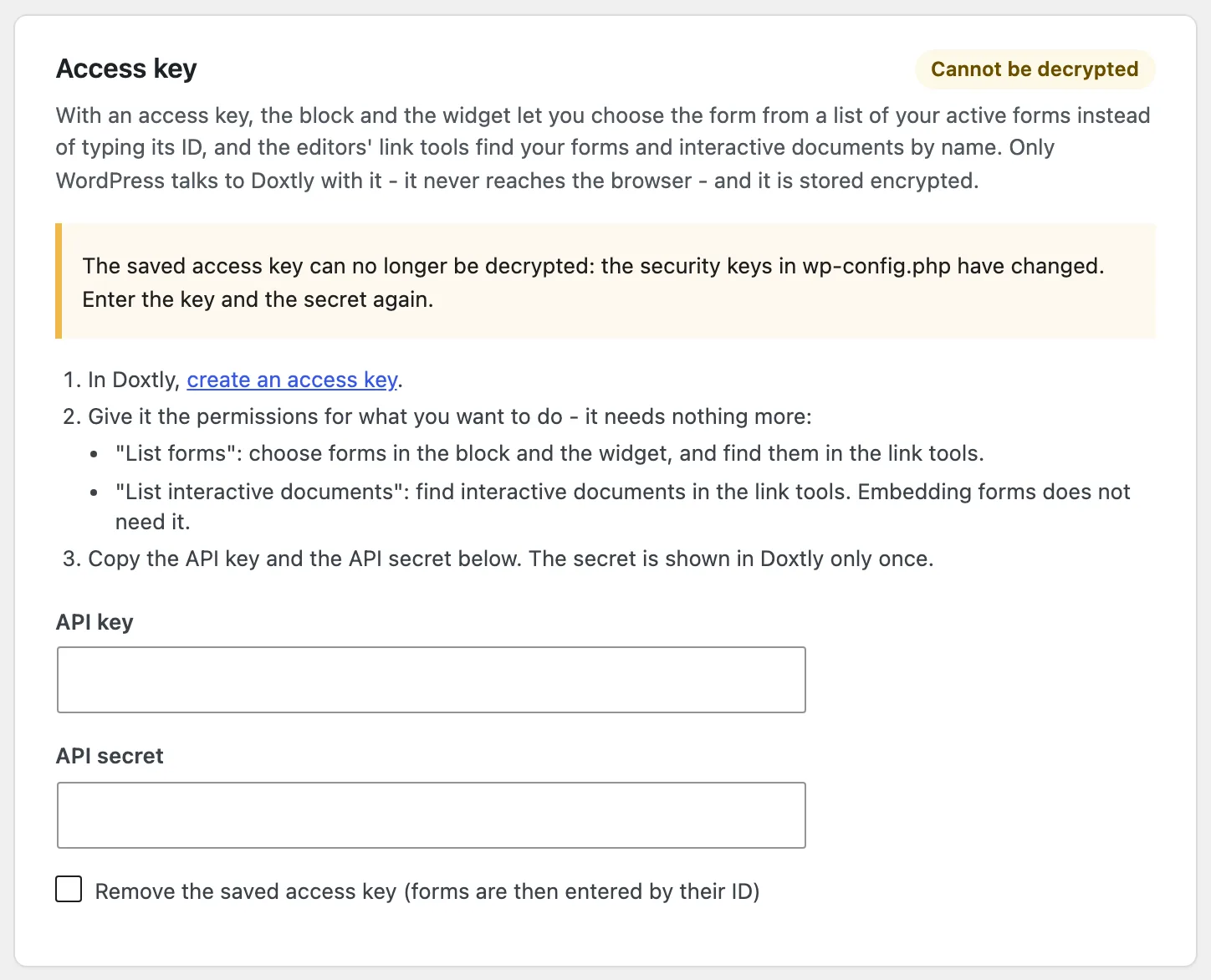
Removing the key
Section titled “Removing the key”Tick Remove the saved access key (forms are then entered by their ID) and click Save changes. Forms already placed on pages keep working. To cut the connection from the other side as well, disable or delete the key in Doxtly.
Embedding a form
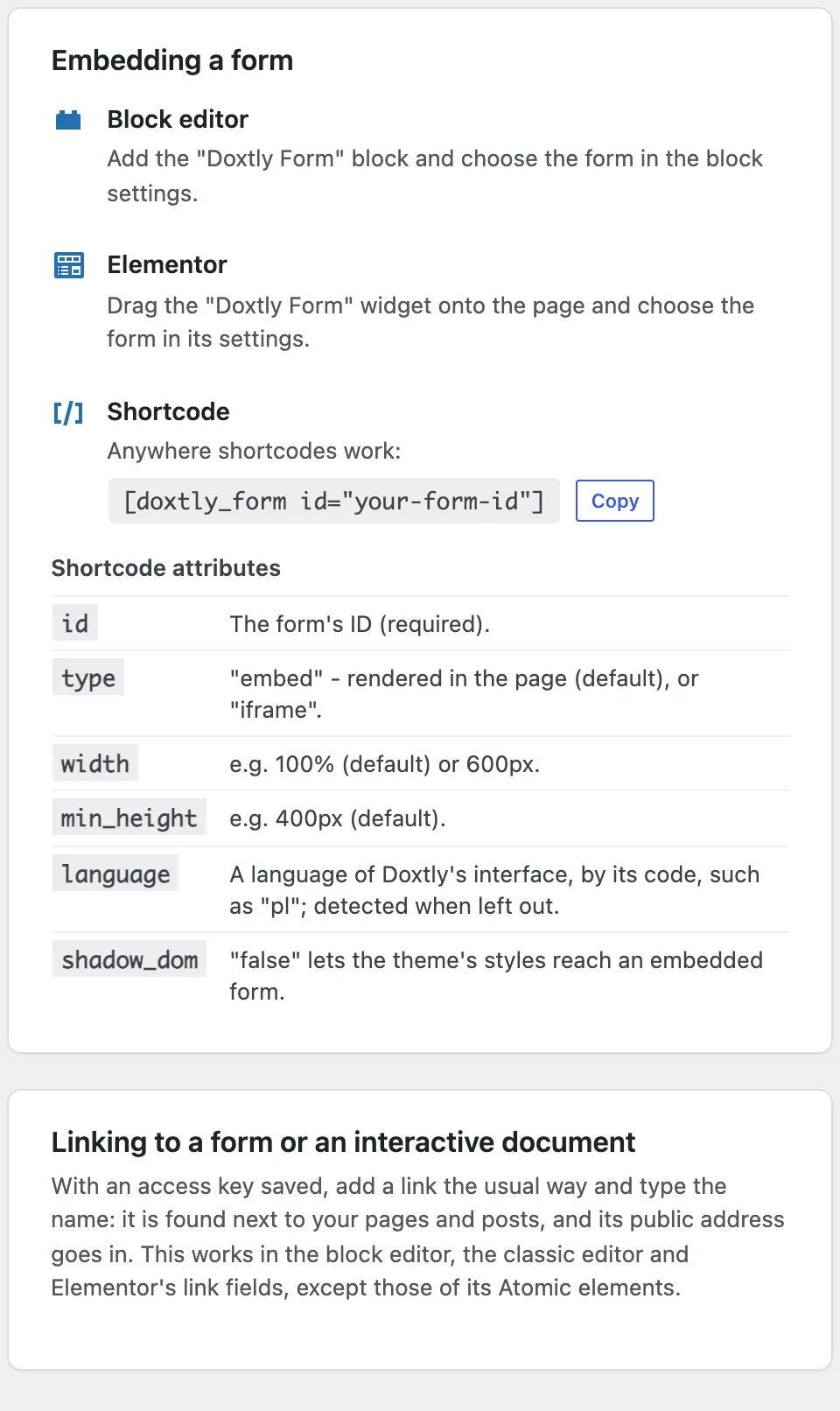
Section titled “Embedding a form”The card on the right is a reminder for whoever opens this page: the three ways to place a form, a shortcode with a Copy button and the list of shortcode attributes. It changes nothing. The copied shortcode holds a placeholder, so replace your-form-id with a real ID. The card below it, Linking to a form or an interactive document, sums up the link tools.
Messages after saving
Section titled “Messages after saving”| Message | What happened |
|---|---|
| Settings saved. | Everything was stored. |
| The settings were not saved: an address is not a valid http(s) URL. | Nothing was stored. Correct the address and save again. |
| The addresses were saved, but the access key was not: enter both the API key and the API secret, without spaces. | The addresses are stored. A key needs both halves, and neither may contain a space. |
| The addresses were saved, but the access key was not: this site has no encryption key outside the database to store it with. | See Where the encryption key comes from. |
Who can do what in WordPress
Section titled “Who can do what in WordPress”| WordPress user | Can |
|---|---|
| Administrators (anyone who may manage options) | Everything on this page, and they get an Open the settings link in the editors’ notices |
| Anyone who may edit posts: contributors, authors, editors | Place forms, load the list of forms and find forms and interactive documents in the link tools. They do not see this page. |
| Everyone else | Nothing. Visitors only see the published forms. |